
Art Box portal //
The 61st International Art Exhibition of La Biennale di Venezia, In Minor Keys by Koyo Kouoh, will run from Saturday, 9 May to Sunday, 22 November 2026 at the Giardini, the Arsenale, and in various locations around Venice. The pre-opening will take place on May 6, 7, and 8, while the awards ceremony and inauguration will be held on Saturday, May 9, 2026.
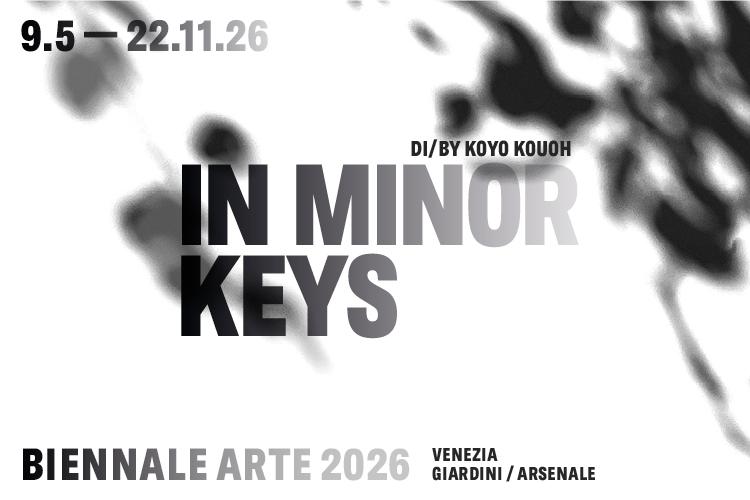
After the premature passing of Koyo Kouoh in May 2025, with the full support of her family, La Biennale di Venezia decided to carry out her exhibition in order to preserve and widely disseminate her ideas and the work she pursued with dedication until the very end. Appointed Artistic Director of the Visual Arts Department in November 2024, Kouoh had already fully developed the curatorial project: defining its theoretical framework, selecting artists and works, shaping the graphic identity and exhibition design, and establishing dialogue with the participating artists.
In Minor Keys is the title Kouoh chose for the 61st International Art Exhibition, as stated in her curatorial text sent to the President of La Biennale on 8 April 2025. The exhibition is being realised by the team she selected: Gabe Beckhurst Feijoo, Marie Hélène Pereira and Rasha Salti (advisors), Siddhartha Mitter (editor-in-chief), and Rory Tsapayi (research assistant).
Their collaborative work with Kouoh culminated in a key meeting in April 2025 at RAW Material Company in Dakar, founded by Kouoh herself. That process remains emblematic of her curatorial approach: relational, collaborative, and open to the unexpected. Since then, the team—working across London, Dakar, Berlin, Beirut, Marseille, Cape Town, and New York—has continued developing the exhibition in close collaboration with La Biennale, through online work and in-person seminars in Venice and Dakar.
As noted by Pietrangelo Buttafuoco, President of La Biennale di Venezia, In Minor Keys articulates Kouoh’s vision of art as a generative, human-centred practice grounded in care, humility, and reconnection with the world—an ethics of “sowing seeds” that her team and La Biennale now bring to life.
The exhibition brings together 111 participants—artists, duos, collectives, and artist-led organisations—from diverse geographies, selected for affinities and resonances across practices. Rather than being organised into sections, the exhibition is structured around conceptual motifs such as Shrines, processions, enchantment, oases of rest, and “Schools” as artist-centred, socially grounded ecosystems. Literary references, including Beloved by Toni Morrison and One Hundred Years of Solitude by Gabriel García Márquez, inform the exhibition’s exploration of memory, thresholds between worlds, and emotional depth.
Key tributes within the “Shrines” honour Issa Samb and Beverly Buchanan, whose practices understood art as generative and resistant to monumentality. The procession motif draws on Afro-Atlantic and carnivalesque traditions to propose collective, participatory spatial experiences, while the “Schools” foreground learning, autonomy, and social responsibility. Themes of rest, ecological memory, and care open spaces for slowing down, deep listening, and multisensory experience.
The Biennale continues to prioritize sustainability, maintaining its commitment to carbon neutrality and ecological responsibility through careful design, materials, logistics, and environmentally conscious practices among participants. The exhibition design by Wolff Architects emphasizes thresholds as transformative portals, guiding visitors through multisensory, immersive experiences. Overall, the 61st Biennale reflects Kouoh’s vision of art as generative, human-centered, and socially aware, blending creativity, collaboration, and ecological mindfulness.
The 61st Venice Biennale continues to place carbon neutrality and ecological responsibility at the core of its vision. From the planning phase to the installation of artworks, the Biennale prioritizes sustainable materials, energy-efficient technologies, and careful logistics management to minimize environmental impact. For instance, many participating artists use recycled or locally sourced materials in their installations, while large-scale structures in the Giardini and Arsenale incorporate energy-saving lighting and solar panels. Transportation of artworks and artists is being optimized to reduce carbon emissions, and the Biennale encourages virtual or hybrid participation when possible. Visitors are invited to engage with the exhibition thoughtfully, fostering awareness of the interconnectedness between human creativity and the natural world.
Beyond operational measures, the Biennale reflects an ongoing commitment to integrating environmental ethics into the very fabric of contemporary art. Sustainability is not just a technical consideration — it informs the curatorial approach, spatial design, and even the themes of the artworks, making ecological awareness an experiential dimension of the exhibition itself. In this way, the Biennale positions itself as a model for how large-scale cultural events can balance artistic innovation with environmental responsibility.
Leave a Reply