
Written by: Dragan Vojvodić //
The exhibition Georg Baselitz: A Life in Print (4 October 2025–22 February 2026), presented at the KODE museum in Bergen, Norway, offers a retrospective overview of the graphic oeuvre of one of the most significant contemporary artists, whose artistic expression has continuously evolved over more than six decades while remaining firmly at the center of the international art scene.
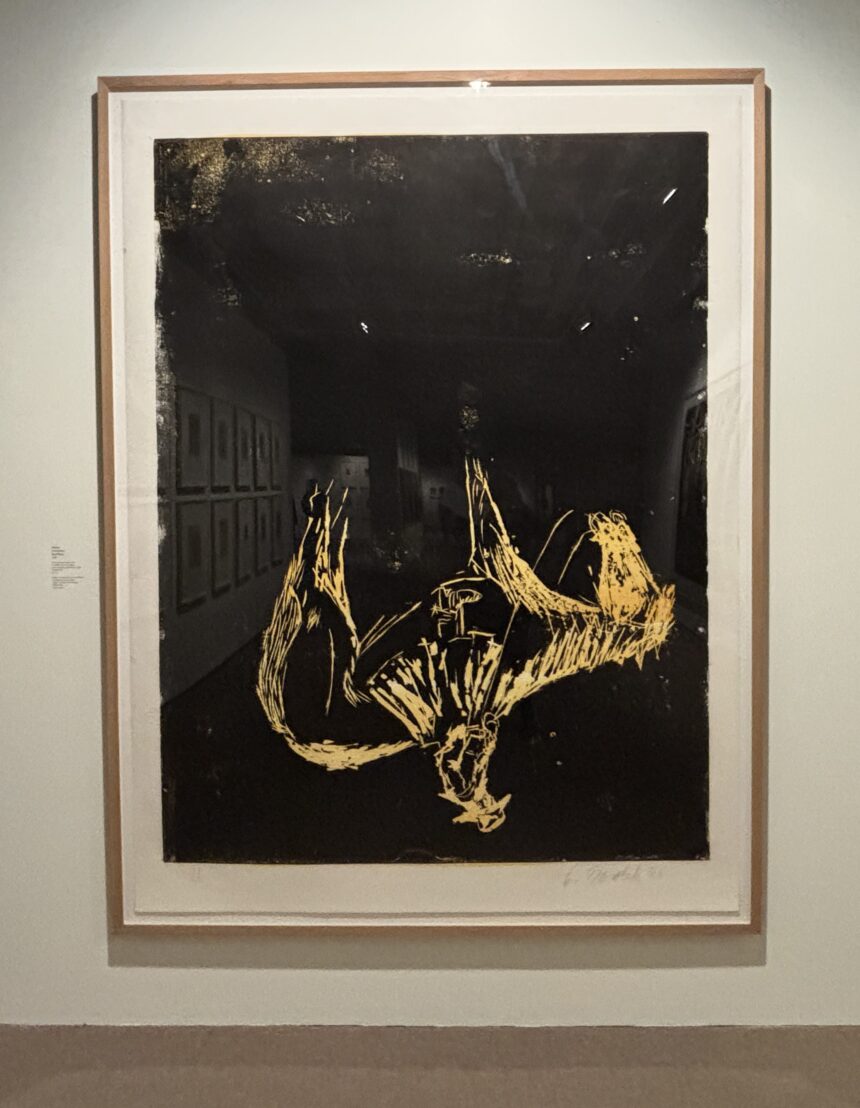
Printmaking as a Site of Resistance and Repetition
This retrospective exhibition, comprising approximately 250 works (prints, with the exception of three sculptures), represents the most extensive presentation of Georg Baselitz’s graphic oeuvre to date. At the same time, it constitutes an effort to reaffirm printmaking as an autonomous and critical field within the artist’s practice, which for decades has been predominantly interpreted through the lens of painting.
For Baselitz, printmaking has never been a secondary or auxiliary discipline. He has engaged with it on equal terms since the 1960s, consistently focusing on gesture, variation, and the materiality of the work. The obsessive motifs that define his artistic language—heroes, eagles, forests, fragments of the body, as well as portraits of his wife Elke—are never abandoned, but instead return cyclically in altered forms. It is precisely within printmaking techniques that Baselitz demonstrates, as convincingly as in painting, his capacity for innovation and for the continual variation of the same motifs.
His heroes are anti-heroes. Their disproportionately large bodies, with exposed genitals and extremities hanging toward the ground, set within empty landscapes or forests, speak of vulnerability—the very opposite of myths that celebrate the victorious side. Eagles, once symbols of the Nazi emblem, are now free yet inverted, stripped of any triumphant significance.
Portraits and human bodies, likewise depicted upside down, are further destabilized by Baselitz, undermined and fragmented. The portraits of his wife Elke, to which he repeatedly returns, constitute perhaps the most intimate segment of his oeuvre. They do not merely depict an emotional relationship, but also function as psychological self-portraits of the artist—portraits of the postwar German subject that are at once personal and universal.
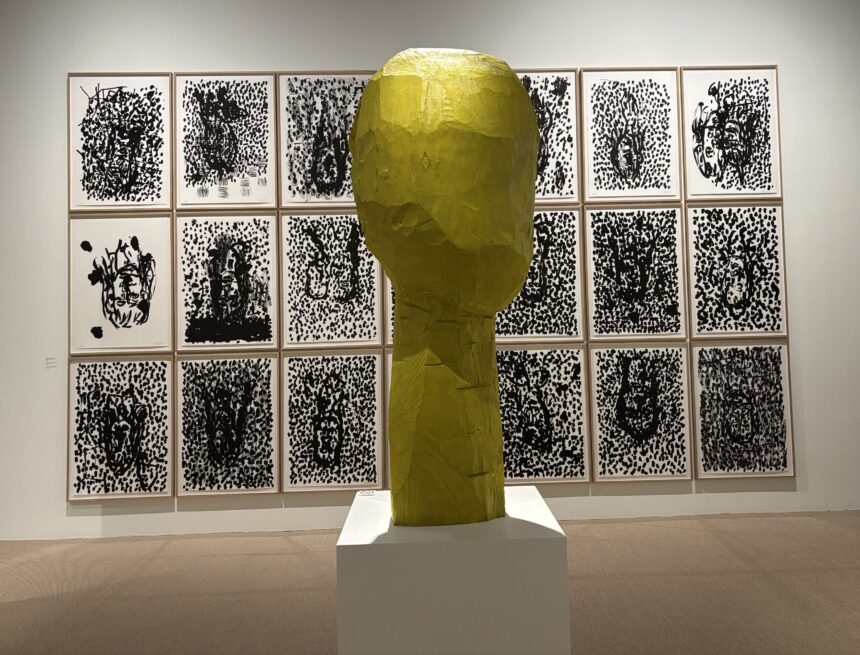
The exhibition’s curator, Cornelius Tittel, has structured the presentation of Baselitz’s graphic works thematically, yet without guiding the viewer toward a narrative or interpretative resolution of the artist’s procedures. On the contrary, the exhibition insists on a continual destabilization of meaning, generated through variations of identical motifs and their constant displacement.
Baselitz consistently rejects the imperatives of contemporary trends and technological innovations. He does not embrace industrial printmaking techniques such as screen printing and offset, instead remaining faithful to slow, traditional processes—drypoint, woodcut, linocut, etching, and aquatint—in which material resistance and limited editions are integral to the work. This decision is not merely aesthetic but also ideological: for Baselitz, printmaking is a space of control as well as uncertainty, in which error is an inevitable and productive part of the process.
Within his graphic oeuvre, the artistic references to which he repeatedly returns are clearly legible. Above all, there is a dialogue with his predecessors, and particularly with Edvard Munch, with whom he shares an understanding of the figure as a site of psychological and historical tension.
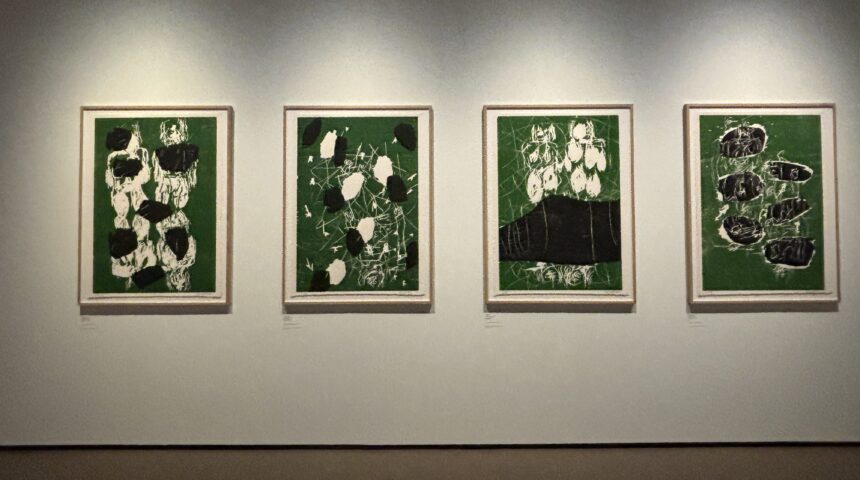
Georg Baselitz as One of the Pioneers of Neo-Expressionism
Georg Baselitz is one of the key pioneers of Neo-Expressionism, a movement that, during the 1980s, marked a historical moment of postmodernism’s return to painting. His work came to the center of attention in 1969, when he introduced the upside-down procedure—turning motifs upside down—thereby radically breaking with narrative readings of the image and shifting the focus to its formal and material aspects.
This gesture can be understood as both conceptual and ideological, and in that sense profoundly radical. Although Baselitz paints in a highly expressive manner that destabilizes and even disintegrates motifs, they nevertheless remain recognizable. Becoming aware that content inevitably comes to dominate the image, the artist inverts the motif in order to prevent immediate recognition and automatic interpretation. He himself explains this procedure with the words: “The painting represents nothing—it remains only a painting.”
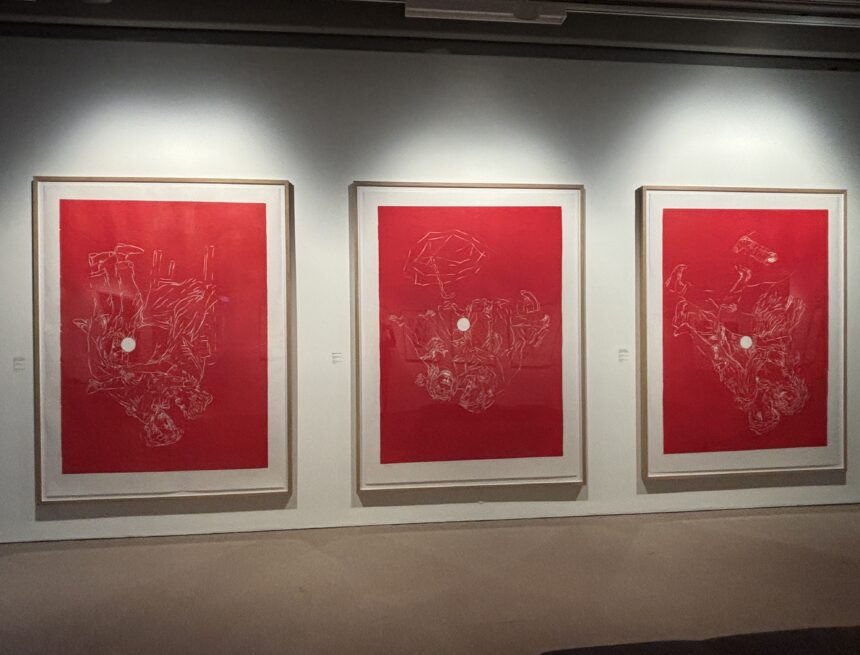
Photo: Art Box portal
Baselitz abandons the understanding of the painting as a “window onto the world” and positions it in an in-between space between figuration and abstraction. The painting no longer represents—it confronts the viewer through its materiality, surface, gesture, and structure. For Baselitz, painting is not a field of spontaneity or authentic expression; it is a construction.
This procedure is not only conceptually grounded but also deeply ideological. Growing up in a devastated postwar Germany—a society in which order and authority had been compromised, ideologies had lost credibility, and notions of heroism had become hollow—Baselitz develops a visual language of a collapsed world. By rejecting the “correct” orientation of the image, he abolishes any stable point of reference. His painting does not attempt to repair or reinterpret the world—it presents it as it is: unstable.
Leave a Reply