
Written by Ljiljana Maletin Vojvodić //
Although Karl Ove Knausgård (1968) now lives in London, I constantly associate him with Bergen. The city I returned to this winter for an artist residency is also the place where I first “encountered” Knausgård — admittedly, not through reading, but through a question. During an interview, my Norwegian interlocutor asked me what I thought of the “Norwegian Proust,” implying that his books, having already gained him literary fame in Norway, were part of my reading experience. My Struggle (Min Kamp, 2009–2011) had not yet been published in Serbia at the time, but since I was already in Norway, my search could begin.

I first discovered the opening volume of My Struggle at the city library and later purchased it at a local bookstore. I read Knausgård first in English, then in Serbian, and back to English again — depending on where I was staying and which of his books were available to me. At home, but also in Bergen, Oslo, and Stavanger, the text took shape differently — shaped by its context.

This winter, I arrived in Bergen carrying The Third Realm (Morgenstjernen 3: Det tredje riket, 2022) in my suitcase, translated by Radoš Kosović and published last year by Booka in Belgrade, without anticipating that Knausgård would once again mention Bergen in it.
I read the book in the city library, in Bergen cafés, and in my studio—located in a former sardine factory with a view of the fjord, where Knausgård himself learned to write—in spaces that are meaningful to me, just as Bergen was important for Knausgård during his formative years, and evidently later as well.

Although it differs from My Struggle in many respects — above all in that it is not autofiction — The Third Realm resembles Knausgård’s hexalogy in both scope and narrative strategies. Despite being a work of fiction, it employs techniques familiar from his autofictional writing: meticulous descriptions of everyday actions, characters’ self-reflection, and sustained thematic explorations of family, the relationship between the personal and the familial, music, history, and art. This time, however, Knausgård combines reflective and psychological layers with elements of the crime novel, horror, mystery, and science fiction, engaging motifs of demonism, the realm of the dead, murder, and oneiric and metaphysical deviations from reality.
The plot unfolds over the course of three days, and its nonlinear, fragmentary narrative is told by nine socially and psychologically convincing narrators. Among them are characteristically Knausgårdian figures: caught in spiritual, familial, and emotional confusion; mired in everyday life yet equally absorbed by questions of life, death, and meaning. As the narrative develops and grows more complex, some of the characters come into contact with one another, and their stories gradually intertwine, so that they are connected not only by the strange star in the sky, which first appeared in the opening volume of the Morning Star cycle.
The atmosphere generated by this star — which will cease to shine on the third day — also evokes, in a certain way, the mood of Trier’s Melancholia, and the characters respond to its presence in markedly different ways. Some of them are familiar to readers from The Morning Star, the first volume of the planned pentology, but the narrative perspectives are now altered: the same events are refracted through narrators who had previously occupied marginal positions.
Thus, for example, an event narrated in The Morning Star by Arne, a university professor of literature, is given another side in The Third Realm: here it is his manic-depressive wife, the artist Tuve, who speaks about herself. Her story both opens and closes the novel, and the narration is further complicated by the intrusion of one of the voices that only she can hear. Instead of her mother, who served as a narrator in the first volume, this installment also gives voice to nineteen-year-old Line, who falls in love with the mysterious Valdemar, the frontman of an equally mysterious band. Likewise, rather than the priest Katrine, The Third Realm is narrated by her husband Gaute, a teacher, who — unlike readers familiar with the events of The Morning Star — does not know that his wife has not been unfaithful, and so on.

Bergen is not merely a backdrop in Knausgård’s books. It is the city of his formative years, the place where his relationship to literature, reading, and writing took shape — most explicitly described in the fifth volume of My Struggle, but also present in The Morning Star and The Third Realm (for instance, in the scene where the police officer Geir, who is investigating the deaths of members of a metal band, sits with his wife on a Bergen quay, sharing a bag of fresh shrimp, and the like).
“Fourteen years that I spent in Bergen, from 1988 to 2002, are long gone; there is no trace of them except in the form of events that perhaps a few people remember, a flash of memory here, a flash of memory there, and, of course, everything that exists in my own memory of that time. But, surprisingly, there is very little. All that remains of the thousands of days I spent in that small, narrow city, shining under the rain in Vestland, are some events and a lot of feelings,” Knausgård wrote on the opening pages of My Struggle, probably not anticipating that one of the ways to “read” this city would be through a literary walk, called City Walk: In the Footsteps of Karl Ove Knausgård. The first of this year’s series is scheduled for February 6 at noon, led by Professor Frode Helmich Pedersen from the University of Bergen.
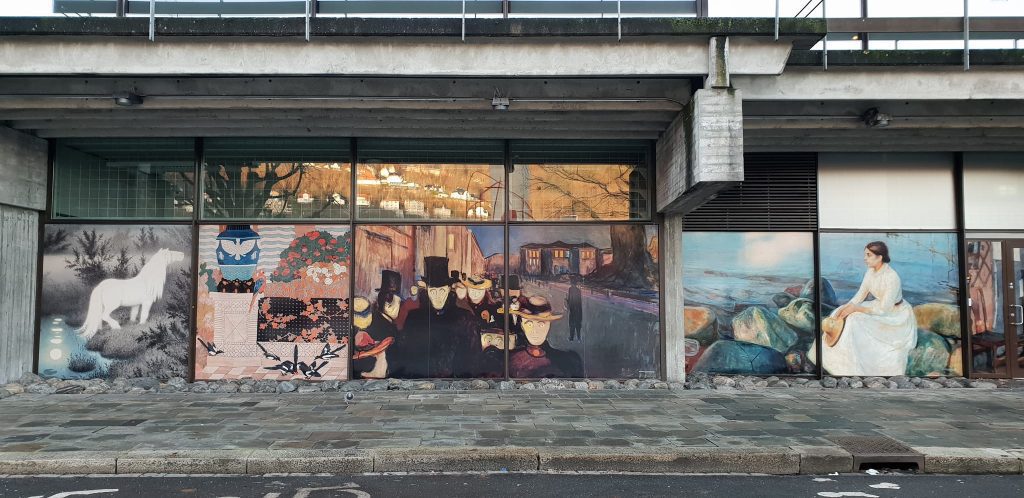
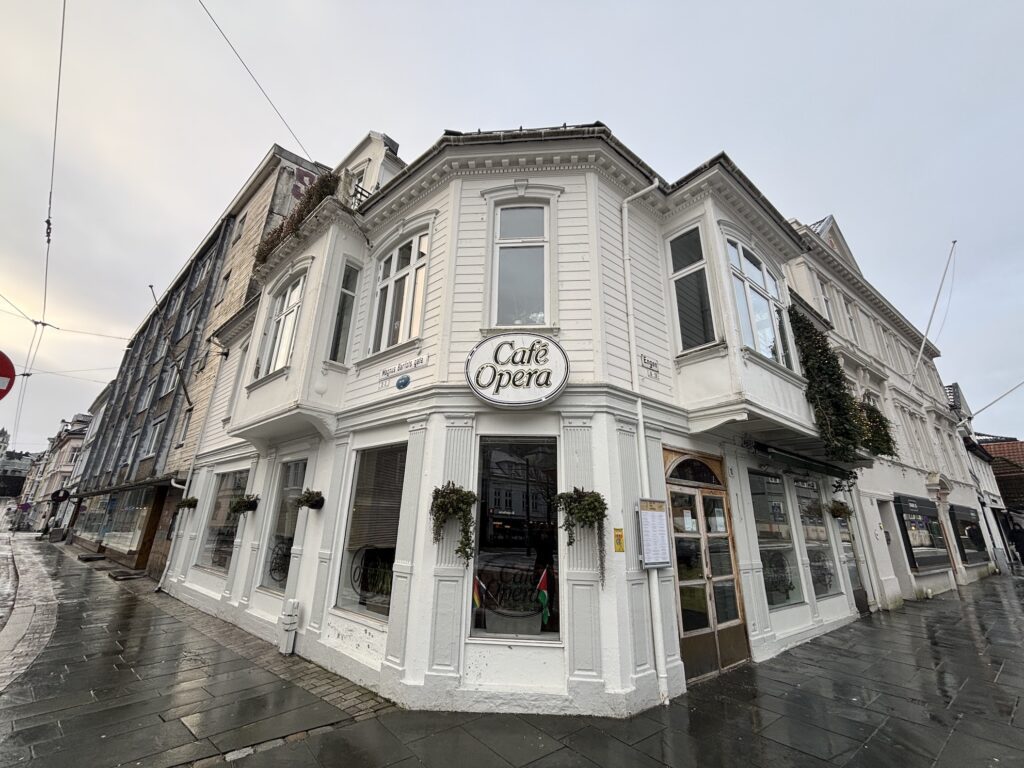
I assume that this literary walk will include a visit to the KODE museums, whose Rasmus Meyer Collection holds one of the most significant collections of Edvard Munch. It is well known that Munch is one of Knausgård’s favorite artists. The route will likely pass through the residential neighborhoods where Knausgård lived, go by Café Opera, along the streets of Nordnes, and reach the Writing Academy — an institution connected not only to Knausgård but also to many Norwegian writers such as Vigdis Hjorth or the Nobel laureate Jon Fosse. I visited the Skrivekunstakademiet only two years ago, even though its professors had recommended me for my first literary residency in Norway, when I conducted an interview with its director, the Norwegian writer and translator Sivert N. Nesbø.
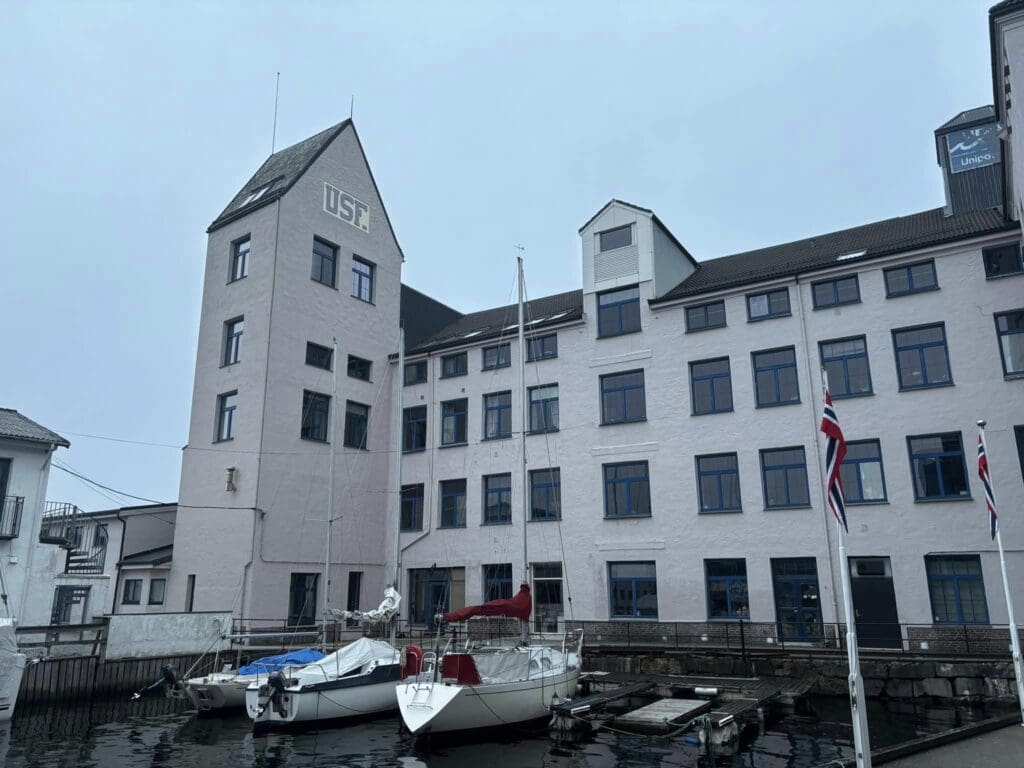
This Academy, located at USF Verftet on Nordnes, has been shaping Bergen’s literary scene for decades: every year, new generations of students come to the city, and many of them stay, becoming part of the local literary milieu. Knausgård studied there in the early 1990s, Jon Fosse taught from 1986 to 1993, and the Academy continues to enroll new generations today — among whom there will, almost certainly, be future writers once again.
Leave a Reply