
Art Box portal //
In the Nordic countries, public spaces such as swimming pools and saunas play an important social role. They are not merely places for recreation or relaxation, but also sites of everyday encounters and social equality. Outdoor bathing, even during the winter months, is a well-established practice in Iceland, Norway, and Finland, where attitudes toward the body, nature, and community are shaped through clearly defined, customary codes of conduct.

A local Icelandic saying captures this succinctly: “If you want to meet the British, go to a pub; the French, go to a café; and if you want to meet Icelanders, go to the pool.” Experience in Iceland confirms this claim — outdoor swimming pools are visited year-round, regardless of weather conditions or season. In Finland, saunas play a similar social role, while in Norway and Sweden, these practices overlap, especially in coastal cities.

In Bergen, one such space is located near the USF Verftet cultural center, where a floating sauna is moored along the waterfront. A sauna visit involves alternating between heat and cold: entering the heated space and then stepping outside or into the water. Saunas are entered clean, with dry skin, and the use of a towel is mandatory. The rules are clear: conversation is kept quiet, entries and exits are brief, and proper hydration is essential to prevent dehydration.
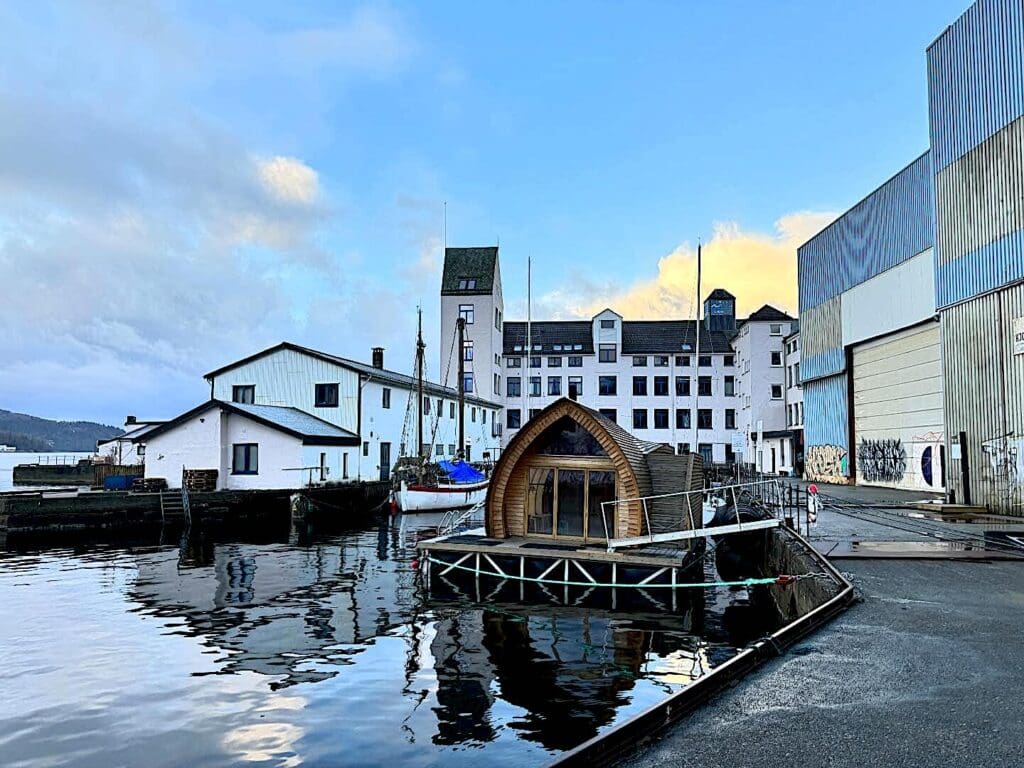
Unlike the Finnish tradition, where sauna use is often without swimwear, saunas in Norway are generally used in bathing suits. This difference points to nuances within a shared Nordic body culture, but it does not change the essence of the experience: controlled exposure to temperature extremes.
Entering an outdoor pool in winter also involves confronting discomfort. After showering, stepping out into the cold air with wet skin produces a brief shock, yet this moment is an integral part of the ritual. In saltwater pools, where the temperature is usually above 30 degrees Celsius, the body recovers quickly, and being immersed in water under the open sky becomes an experience that combines physical pleasure with mental release.
Specific rules also apply in the changing rooms. These are not merely functional spaces, but places where, symbolically, shame is left behind. Men’s and women’s changing rooms are separate, and the rule of thorough showering before putting on a swimsuit implies an absence of embarrassment. Gazes do not linger on other bodies, privacy is taken for granted, and the body is not treated as a sexual object.
After time in the pool, returning to the sauna brings a strong contrast: warmth first spreads through the head and upper body, while the extremities heat up more slowly. More experienced visitors choose the higher benches, closer to the ceiling, while beginners stay lower down. From time to time, water is poured over the heated stones, raising the temperature and humidity and further intensifying the experience.
Cycles of heat and cold are repeated several times, until exhaustion finally prevails. The end of the ritual often includes a warm drink—coffee or tea—and a feeling of heaviness in the body, slowed movements, and pleasant fatigue. Despite winter conditions, the experience is often described as a form of “winter vacation,” characteristic of Northern Europe.
Despite the high standard of living, entrance fees to pools in Nordic countries are generally affordable, which further confirms their role as a public good. It is also important to note that photography in saunas and pools is strictly prohibited (a rule tourists often ignore), in order to protect privacy and the immediacy of the experience. In a time of constant visual documentation, this practice makes time spent in water and saunas one of the rare experiences preserved exclusively in personal memory.
Leave a Reply