
Written by: Ljiljana Maletin Vojvodić //
Artists are expected to arrive at an artist in residence with a clear project and plan. Yet an artist residency is never just a space; it is a context that, sooner or later, determines a new theme — often more significant than the one originally planned. We write about one of these important themes on December 18, International Migrants Day, established by the United Nations General Assembly in 2000.

Cité internationale des arts: Expectations and Experience
In the year when Paris’s Cité internationale des arts celebrated its sixtieth anniversary, I stayed at this artist residency alongside multimedia artist Dragan Vojvodić, and the theme that naturally emerged was homelessness. Despite different initial plans, living alongside young homeless migrants from Africa drew us back to our long-term project exploring concepts such as home, homelessness, the liminality of identity, and social invisibility.
Founded in 1965, the Cité internationale des arts is one of the oldest and most significant artist residencies in the world. Each month, it hosts over 300 artists from more than a hundred countries. During July and August 2025, Dragan planned to focus on sound, while I intended to write about invisibility in contemporary art within the context of gender politics. However, the immediate environment of the residency once again connected us to our collaborative project, The Meaning of Home in Today’s World: Farsickness, Homesickness, Homelessness from 2021.
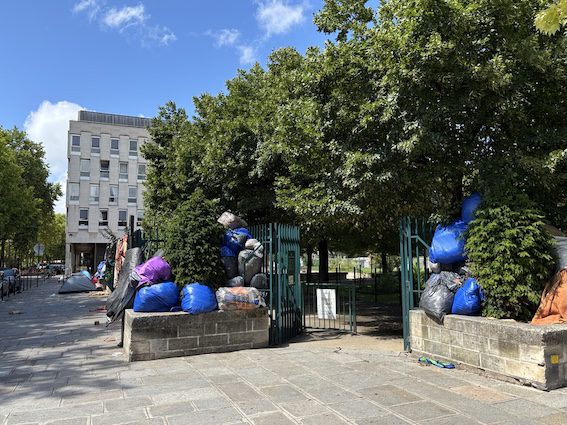
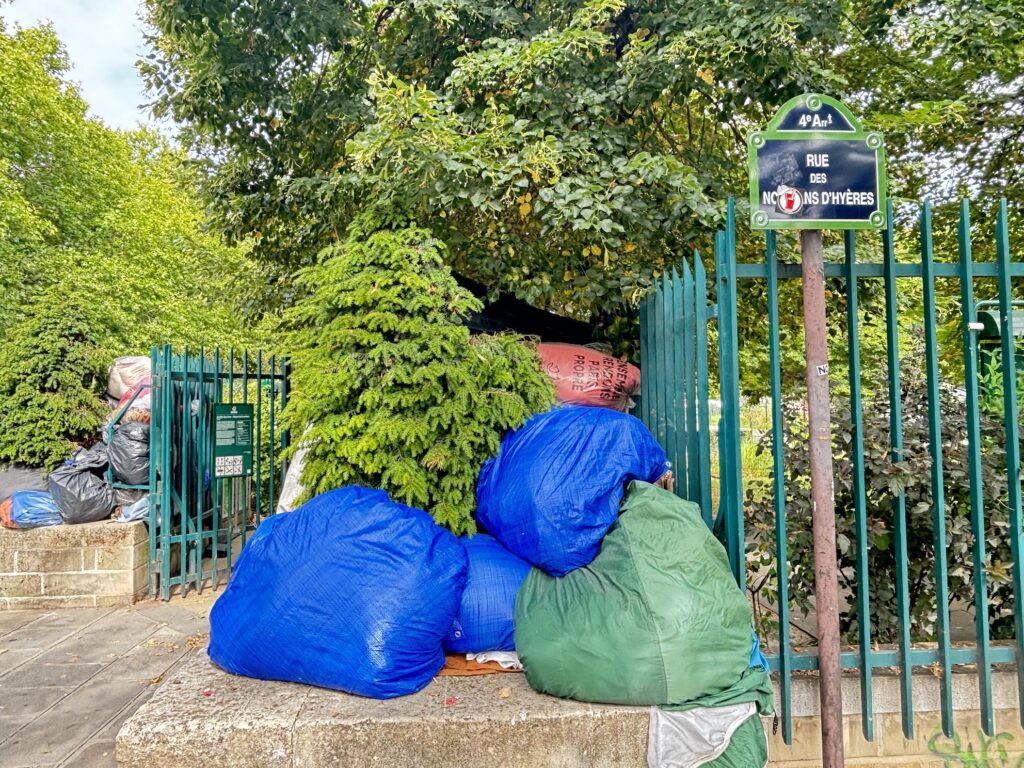
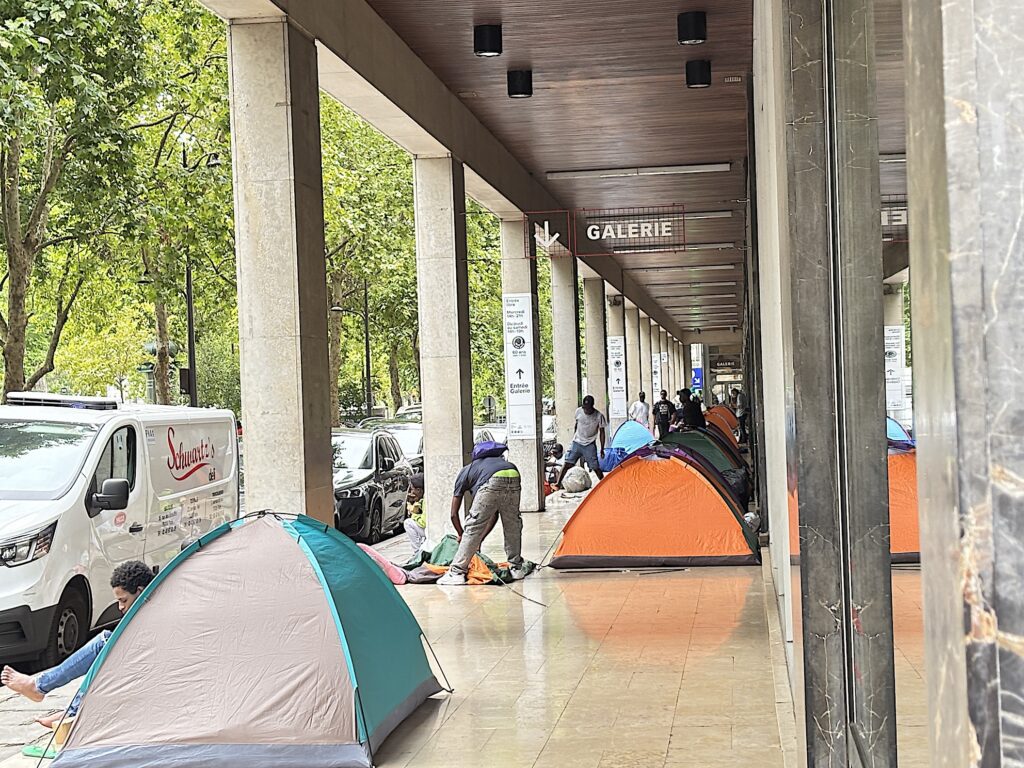
Between 50 and 100 young men from Mali, Senegal, Ivory Coast, Guinea, Eritrea, and Sudan — without documents or homes — slept every night under the covered passage of the Cité, right beneath the windows of our studio. During the day, the homeless were invisible — their tents hidden, trash removed, streets cleaned — but in the evenings they returned to their “safe place.”
“Migrants” and/or “Homeless People”
Observing young homeless people from Africa, I saw how terms such as “migrant” or “person without a home” are interpreted in practice through assumptions and value judgments. I had to become aware of how these filters also shape my own perception of reality. In the broadest sense, migrants are people on the move — temporarily or permanently, for economic, political, or personal reasons. “Persons without a home” are those without a stable place to live. However, although these terms may sound neutral, they are most often used as discriminatory labels. We often forget that those living “on the move” or “outside the home” — “unsheltered people,” experiencing “invisible homelessness,” “asylum seekers,” “irregular migrants,” “unaccompanied minor migrants,” or “undocumented minors” — are not without identity, memory, or past.
When the authorities cannot provide more concrete and sustainable support, they often resort to a strategy of so-called passive tolerance — silently allowing homeless people to sleep in public spaces, including the area in front of the Cité. Such a practice may appear as an expression of empathy, but it also reveals the limitations of inclusivity in everyday life.
Who are the young homeless people from Africa?
Most of the young African Parisian homeless are asylum seekers, refugees, or undocumented migrants. Some are accommodated in camps, temporary centers, or government-paid hotels; many, however, remain without housing and sleep on the streets, which makes them homeless by definition. Since the state does not have enough capacity to house all asylum seekers, many wait for months to be registered, and some are not entitled to accommodation because they lack a formal status, leaving them without shelter.
The young homeless in front of the Cité have fled war, poverty, political persecution, or climate disasters. While awaiting a decision on their asylum application, they live on the streets. Most are minors or present themselves as such to obtain protection, which further shapes their “invisibility.”
Claiming minority status is a common practice because minors receive greater protection. “Unaccompanied minor migrants” (Mineurs non accompagnés) often have no documents. Abuses and misjudgments are common, and institutional suspicion often places them in a liminal state—they are neither children nor adults, neither citizens nor deported. This situation puts them in a paradoxical position: they cannot be deported, but they cannot fully access the system either. The state “tolerates” their presence, but does not formally recognize them.
Art Residency and Invisibility
Since many artists in the residency are themselves migrants or have migration experience, the question arises: what does it mean to create in an environment surrounded by invisible young people in the middle of Paris?
There is a clear, though unspoken, barrier between the artists and the migrants: their lives run parallel, sometimes only a meter apart physically, yet with a literal and structural distance. This situation clearly reveals the paradox of contemporary inclusion policies — individuals can be physically present but not fully recognized institutionally.
The young migrants who spend their nights in front of the residency embody this ambivalent zone: they are there, yet institutionally “outside” the social framework. In such circumstances, their presence in front of the Cité becomes more than a social image — it is a mirror reflecting the limitations of artistic and cultural policies that nominally aim for inclusivity. The Other remains marginalized, identified solely by their difference from the center.
The position of young homeless people is not only a political issue but a state of liminal identity: an identity formed at the intersection of invisibility, mobility, and social boundaries—between home and non-home, rights and non-rights, presence and invisibility.
This paradox becomes particularly visible in an artistic context—a space that formally insists on openness and dialogue. To what extent can, should, and may art and artists transcend the boundaries of the observer, and to what extent do they unconsciously participate in reproducing the very invisibility they critique in their work?
What does the daily life of young homeless people look like?
The homeless in front of the Cité are either minors or present themselves as the most vulnerable group within the migration system to obtain protection. Although they cannot be deported, it is difficult for them to access schooling, find work, or secure stable accommodation. They remain in a kind of legal limbo: not fully recognized, yet not formally rejected.
Their clothing, mobile phones, and backpacks are usually their only possessions. At first glance, they do not differ much from average Parisian peers: wearing modern tracksuits, caps, headphones, mobile phones, and backpacks. Even while living on the streets, they take care of hygiene — brushing their teeth and washing their feet every morning and evening at the tap in front of the Cité building. Sometimes they are noisy, which creates tension in the environment, but their lifestyle is a result of hardship, not choice. An inevitable distance forms between the artists who create and the young people who survive. Occasionally, the police appear; humanitarian organizations often bring food or necessities.
The Role of Organizations and Systemic Limitations
Paris has a well-developed network of public, non-governmental, and volunteer organizations that provide support to young migrants and homeless people, yet the number of people seeking protection often exceeds available resources—a situation repeated in many European metropolises. Humanitarian organizations, such as Utopia 56, intervene when migrants sleep on the streets, in front of public buildings, or in other public spaces, assisting homeless people and unaccompanied minor migrants by distributing food, blankets, sleeping bags, and necessities, and helping them find shelter whenever possible. However, due to overwhelming demand and an overburdened system, many remain outside its reach.
Inclusivity and Empathy in Practice
Although the Cité promotes the idea of intercultural dialogue and frequently organizes exhibitions dedicated to the experiences of migrants, everyday interaction between artists and the young people sleeping in front of or beside the building is almost nonexistent — due to fear, language barriers, or institutional constraints.
This distance transforms the space of imagined coexistence into a field of invisibility and social boundaries. Can living alongside those who exist “on the move” or “outside the home” contribute to understanding their problems if it is clear that their perspectives cannot be fully adopted? It also raises the dilemma of how relevant it is for someone not directly at risk to question the position of those who are. Can critical reflection exist without genuine dialogue?
Finally, I am left with a question I ask myself: Why, even though I engaged with issues of inclusivity and empathy, did I not attempt during my stay at the Cité to create a space for genuine dialogue with the young homeless people from Africa?
Leave a Reply