
Interview by Ljiljana Maletin Vojvodić //
Readers of Karl Ove Knausgård’s fifth volume of My Struggle might know USF Verftet as the home of the Writing Academy, where the nineteen-year-old Knausgård studied under Jon Fosse, later a Nobel laureate. But USF Verftet is much more than a literary footnote.
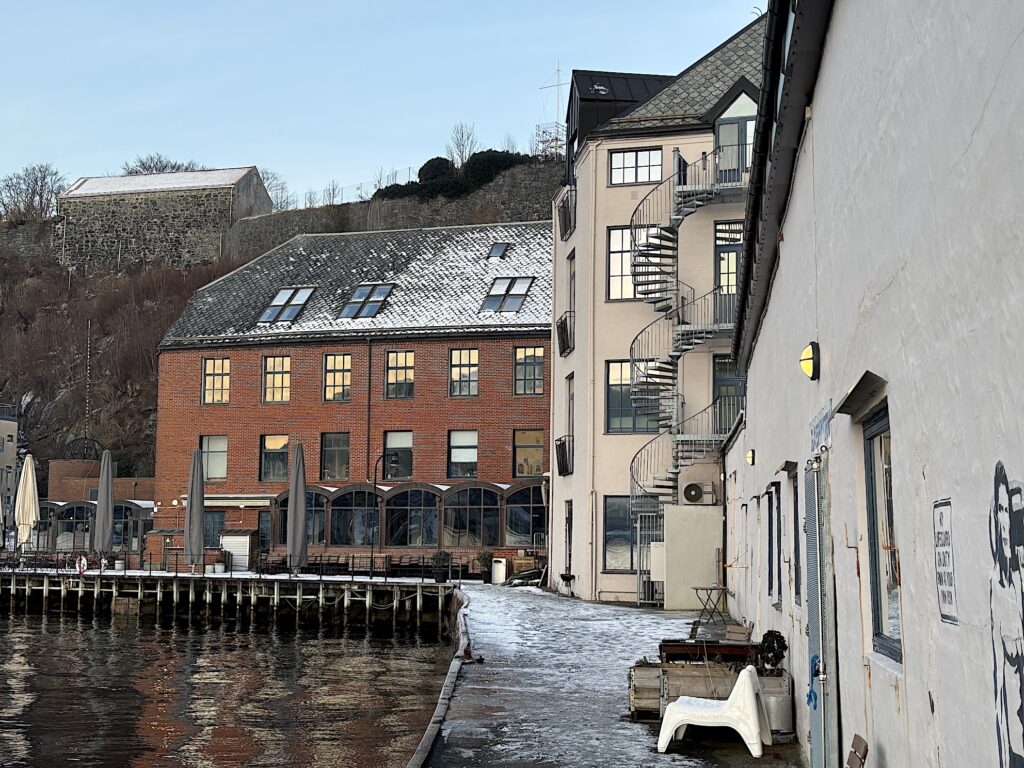
The USF Verftet Cultural Center is located in Bergen, by the sea, on the Nordnes peninsula, in a former sardine factory. Managed by the Stiftelsen Kulturhuset USF foundation, it hosts artists across disciplines: visual arts, music, dance, film, and theatre. The complex has 60 studios for around 80 professional artists, two international residency studios, and offices for music, film, and literary organisations. A cinema, concert and theatre halls, a gallery, and exhibition spaces make it a place of constant exchange and collaboration.
Meeting Line Nord
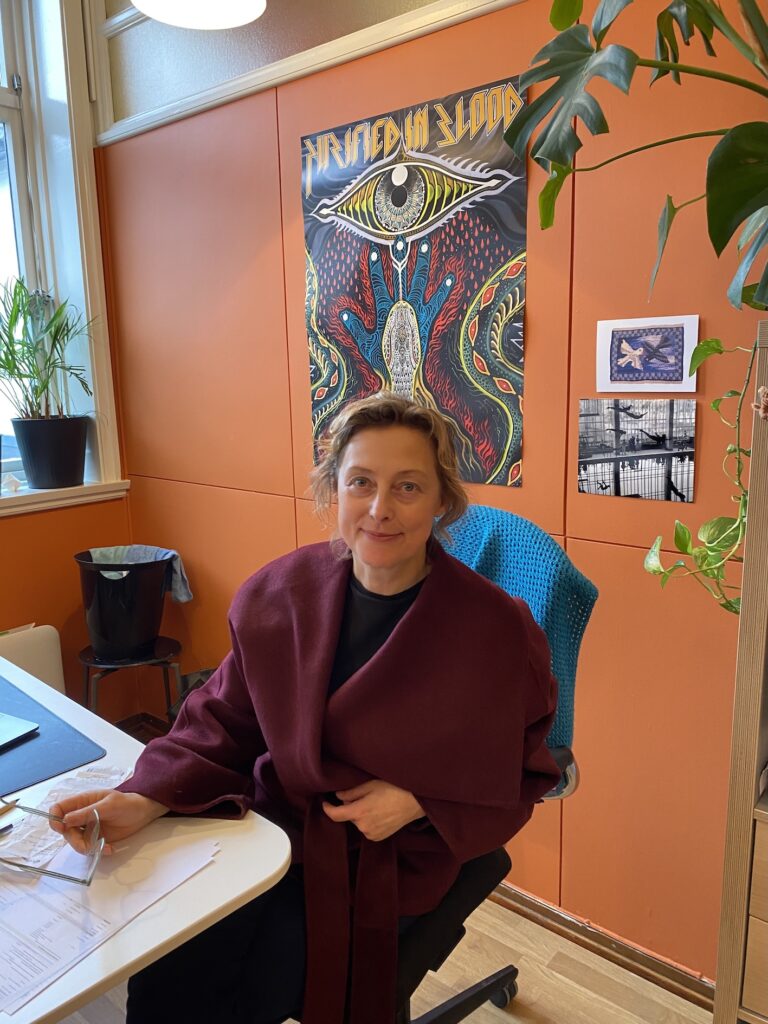
I spoke with Line Nord, gallery curator and manager, and long-time manager of the Artist in Residence programme, whom I first met over a decade ago during my own residency. We met at Kafe Kippers, which also appears in My Struggle, to talk about art, Bergen, and what it’s like to work at a contemporary cultural institution like USF Verftet.
“I’ve been here since 2001, and it still feels like a privilege,” Line says. “I have amazing colleagues, and I love meeting people working in culture every day, in so many different forms.”
Trust Over Control
Line describes what is standard in Norway’s work culture: trust, autonomy, and responsibility.
“Everyone has a clear role but also the freedom to do their work,” she explains. „Work-life balance isn’t just a phrase – it’s real. At USF Verftet, people care about quality, sustainability, and the long-term impact of their work.“
The International Residency
One of USF Verftet’s most recognised programmes is the Artist in Residence initiative. So far, 324 artists from 47 countries have participated, and Line reviews 200-250 applications each year.
“Working on this programme is a gift,” she says, with the same energy and dedication as when I first met her. “But selecting the artists is always the hardest part,” she adds, noting that she remembers each resident individually.
While gender equality, minority voices, and marginalised perspectives are considered, quality is the decisive factor. “It’s not easy with so many applications, which is why experts from different fields help with the evaluation,” she explains.
“Artists choose Bergen for many reasons,” Line continues. “The city is small enough to make personal connections easy, but lively enough that there’s always something happening. Hierarchies are soft, collaborations form naturally, and access to institutions and people is straightforward. And of course, the surrounding fjords, sea, and mountains play a huge role for many.”

Challenges and Optimism
Like many cultural institutions, USF Verftet faces wider social challenges. Bergen, which had supported the international residency since 1999, recently withdrew funding due to budget cuts. The foundation is keeping the programme running with its own resources, reducing residencies and delaying the 2026 application cycle.
Line remains realistic but optimistic. “It’s not easy, but we have plans and the determination to continue,” she says. “The list of artists interested in returning or participating now has over 300 names. The residency programme is important, and we’re working to preserve it.”
Why International Artists Matter
“Why does Bergen need international artists?” I asked.
“Bergen was once a Hanseatic town, outward-looking and connected to the world,” she says. “We’re on the west coast, far from Oslo and the rest of Europe. New influences, conversations, and exchanges are crucial. International artists bring perspectives that stay with the city, through their work and connections.”
Culture Without Borders
When asked about a “typical Norwegian cultural model,” Line is clear:
“I don’t divide culture into ‘Norwegian’ and ‘other’,” she says. “Today’s Bergen is made up of people from many backgrounds. What we call tradition is really the result of mixing. People from elsewhere are very welcome here.”
Balancing Economy and Art
USF Verftet operates as a non-profit, but commercial events such as concerts and large-scale shows fund artistic production. This allows the gallery and other programmes, although costly, to remain central to the local scene.
“Our goal,” Line says, “is to develop and improve quality.”
Audience as Proof of Relevance
USF Verftet is deeply embedded in the local community. More than 1,100 events take place each year, drawing around 110,000 visitors.
The audience is multigenerational, including children in dance classes, daytime film screenings for older viewers, and evening concerts and festivals attracting younger crowds. This openness to all ages, genres, and artistic practices is what makes USF Verftet a vital, living, and essential part of Bergen’s cultural life.
Leave a Reply