
By Ljiljana Maletin Vojvodić //
At the former Konsthallen exhibition space in Gothenburg, the exhibition “Bowie by Sukita” is currently on view, devoted to one of the more remarkable artistic collaborations in the history of popular culture. Featuring more than 100 photographs by Japanese photographer Masayoshi Sukita (b. 1938), the exhibition follows David Bowie (1947–2016) through different stages of his career, while also exploring how an artistic identity can evolve, transform and be continually reinvented.
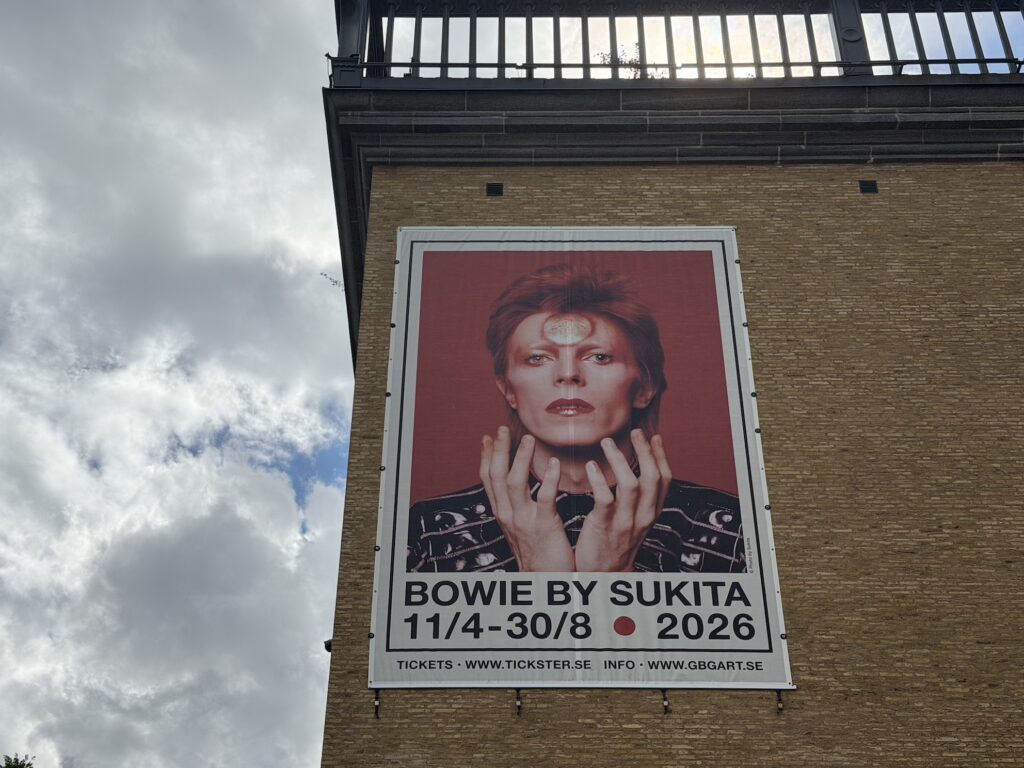
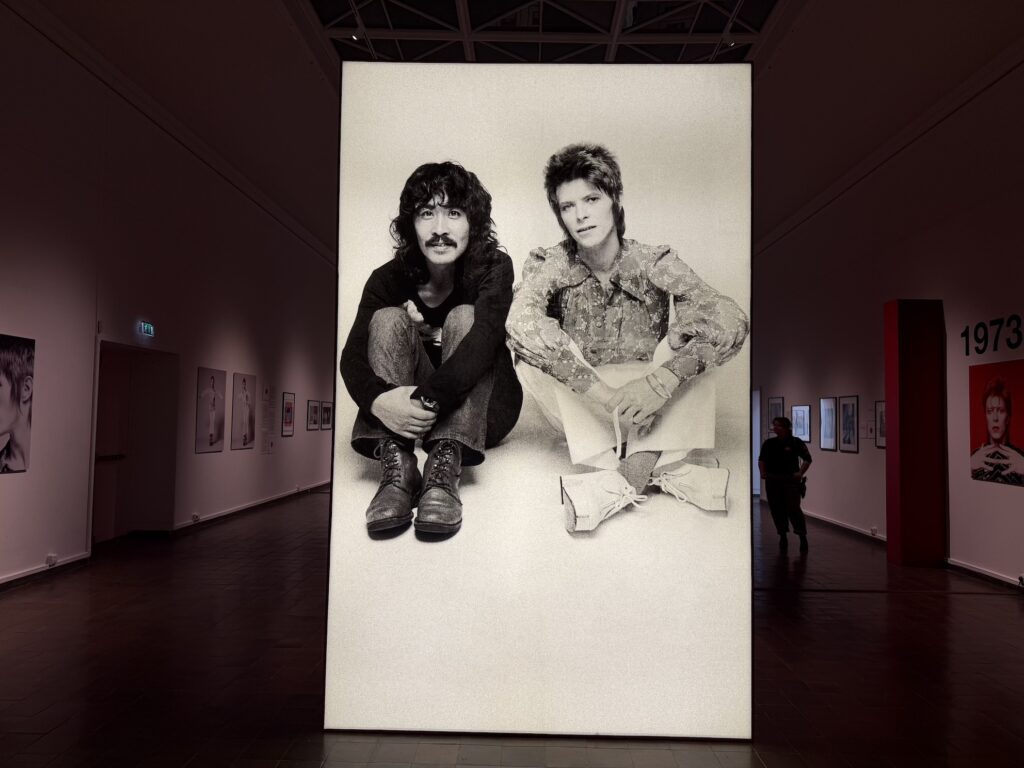
Sukita first photographed Bowie in 1972. Their collaboration continued for several decades, until Bowie died in 2016. During that time, Sukita did more than document the changing image of one of the most influential musicians of the 20th century. He became part of Bowie’s visual world – an observer, but also a collaborator in the creation of some of Bowie’s many personas.
This is why the photographs in the exhibition function as more than documents of a musical career. They speak of transformation – of an artist who never settled for a single identity, genre or narrative.
Bowie’s Fascination with Japan
Bowie’s fascination with Japan began long before his encounter with Sukita. Japanese culture, aesthetics and the tradition of kabuki theatre influenced his approach to costume, the body, movement and identity.
This is particularly evident in the persona of Ziggy Stardust, as well as in his collaboration with Japanese fashion designer Kansai Yamamoto, who created some of Bowie’s most iconic stage costumes.
Elements of kabuki can also be recognised in this aesthetic, where costume, make-up, gesture and movement are not merely decorative but fundamental to the language of performance. Historically, male actors also played female roles, creating a theatrical space for something that would become one of the central ideas in Bowie’s work: the notion that identity is not fixed.
Bowie brought this idea into popular culture. His stage persona was a combination of glamour, cabaret, science fiction, rock and theatricality. What made his aesthetic so distinctive was precisely his willingness to cross different cultural codes and transform them into something new.
Photography Between the Mask and the Face
David Bowie continually reinvented and questioned his own identity, while Sukita’s photographs did more than record his transformations on stage.
In this respect, the photographs taken during Bowie’s private visits to Japan are particularly revealing. He appears in everyday situations: travelling on public transport, walking through the streets, sitting in a Zen garden…
Japan was not simply a source of visual motifs for Bowie. It was also a space in which he could experience a different relationship to the body, space and time.
Heroes: The Geometry of Silence
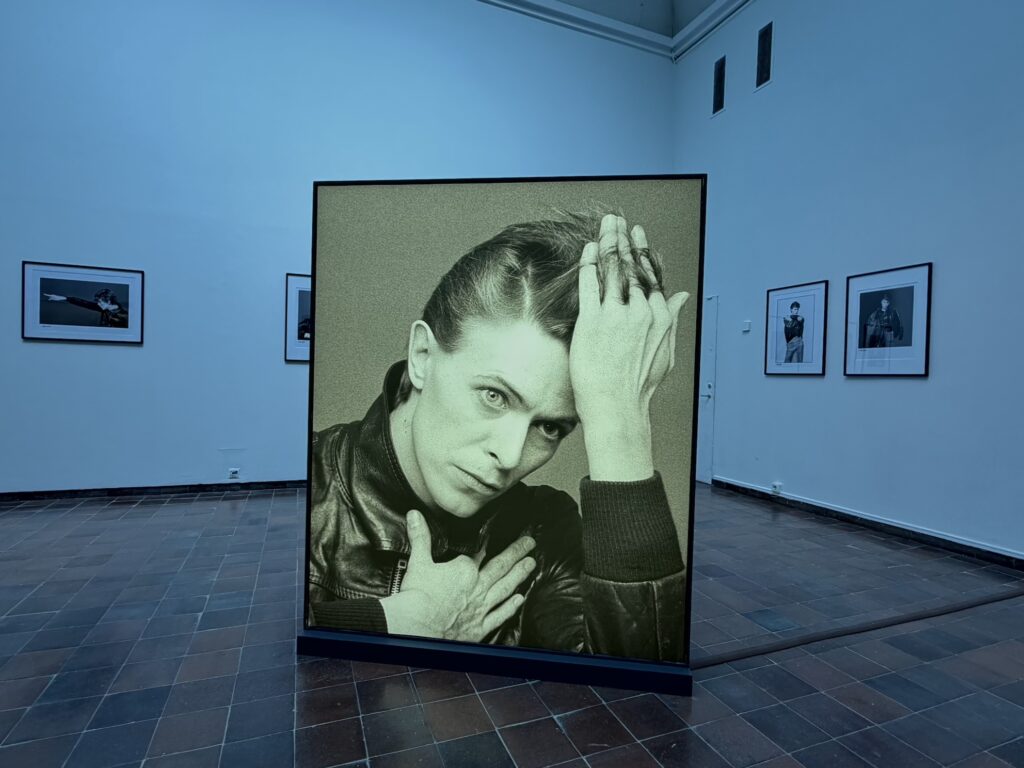
One of Sukita’s most iconic photographs of David Bowie was taken in 1977, during Bowie’s stay in Tokyo, where he was promoting Iggy Pop’s album The Idiot. The photograph Sukita took during that session went on to become the cover image for Bowie’s album “Heroes”.
Almost four decades later, the same photograph was used again for the cover of Bowie’s 2013 album The Next Day, this time with a white square covering his face.
The image thus acquired a new meaning. What was once an instantly recognisable face becomes partially obscured – as if identity itself has become something to question, conceal and reinvent.
More Than a Portrait of a Rock Star
“Bowie by Sukita” is an exhibition of David Bowie’s photographs, but it is also a record of a collaboration between two artists in which Japanese minimalism, kabuki, rock, glam, avant-garde and popular culture intersect.
Sukita’s photographs capture Bowie not simply as a rock star, but as an artist constantly moving between identities, cultures and forms.
The exhibition “Bowie by Sukita” is on view in Gothenburg until 30 August 2026.
Leave a Reply