
By Ljiljana Maletin Vojvodić //
At the Röhsska Museum in Gothenburg, the exhibition We Will Survive: The Prepper Movement and Design opened on 7 February 2026 and will be on view until 4 October. The exhibition explores the prepper movement while also addressing the broader question of how we prepare for a future in which war, natural disasters, pandemics, climate change and different forms of social instability have become part of everyday public discussion.
Prepper culture was long regarded as a marginal phenomenon – somewhat closed off and often associated with individuals and communities preparing for a wide range of disaster scenarios. Today, the situation is different. Questions of crisis preparedness and household readiness have increasingly entered the public sphere, while the prepper movement itself has developed into a global phenomenon encompassing diverse subcultures and different ways of thinking about the future.
In a world facing war, climate change, pandemics and disruptions to the systems that underpin everyday life, preparedness is no longer an idea reserved for those expecting an apocalypse. Many people have, at least once, wondered what would happen if electricity, water, food supplies or communications were suddenly unavailable – and what they would need to have at hand in such a situation.
These are precisely the questions addressed by We Will Survive: The Prepper Movement and Design. The exhibition examines how preppers imagine the end of the world and prepare for it, while also expanding the discussion beyond individual survival to consider how institutions, cities and governments prepare for risk.
The exhibition is divided into three sections: Existential Threats and Risk Assessment, Civil Contingency Planning, and Individual Prepping.
More than 200 design objects, architectural sketches, magazines and historical video materials illustrate the different ways in which design can become a tool for preparing for crises. The exhibition also includes post-apocalyptic scenarios from films and video games, revealing how ideas about the possible end of the world have become deeply embedded in popular culture.
One of the notable elements of the exhibition is the Doomsday Clock, the symbolic clock that first appeared on the cover of Bulletin of the Atomic Scientists in 1947. The clock represents scientists’ assessment of how close humanity is to global catastrophe. Its presence in the exhibition serves as a reminder that the fear of the end of the world is not a new phenomenon. The threats, political contexts and technologies may change, but the need to assess and anticipate risk remains.
The second section focuses on civil contingency planning and governmental approaches to crisis preparedness. Examples from the United States, Naples, Tokyo, Helsinki and Sweden show how governments and cities prepare for war, natural disasters and other emergencies.
A particular focus is placed on the Swedish brochure If Crisis or War Comes, whose content and visual presentation have changed over the years. It offers a telling example of how official messages about preparedness are adapted to changing social conditions and perceptions of risk.
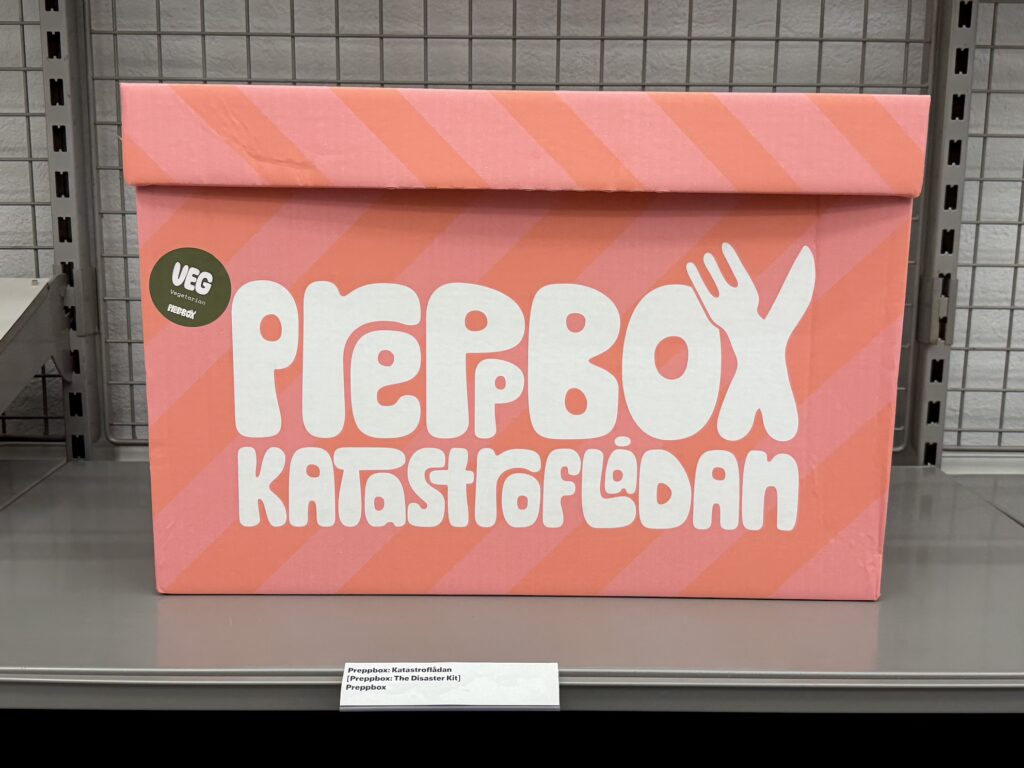
The third section focuses on individual preparedness and survival-oriented design. It takes the form of The Prepper Supermarket, a space designed like a supermarket where visitors can browse products and solutions addressing basic needs such as water, food, warmth and shelter.
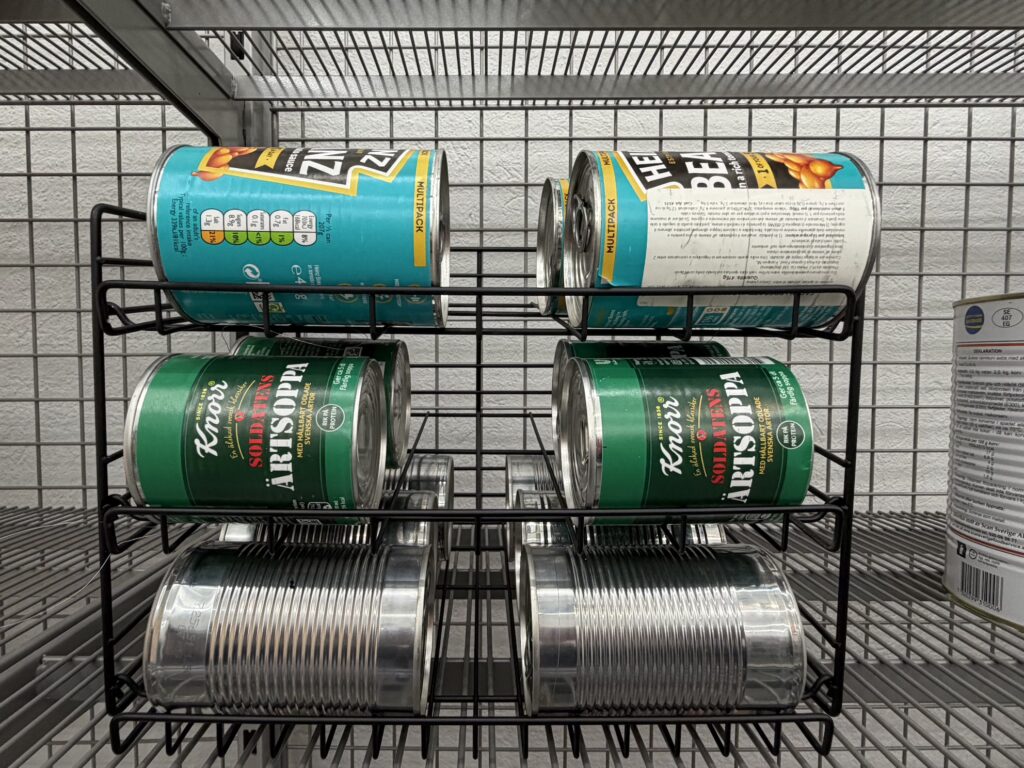
This part of the exhibition particularly clearly demonstrates the relationship between prepper culture and design. Objects that normally belong to everyday life acquire a different function: they become part of an emergency survival kit. Design here is not simply a matter of appearance or practicality; it becomes a way of responding to uncertainty.
At the same time, The Prepper Supermarket highlights the extent to which contemporary survival culture is connected to consumption. Different potential threats are met with different products, equipment and technological solutions. Fear is thus given a material form.
One of the more interesting aspects of the exhibition is the boundary between rational preparedness and fear of what might happen. One does not have to believe in an apocalypse to think about how to respond to a power outage, natural disaster or war. Many such scenarios are already part of official civil contingency plans and government recommendations.
This is why We Will Survive does not present preppers simply as an unusual subculture. Instead, it places them within the broader context of a society that has become increasingly aware of its own vulnerability.
The exhibition also raises a question that runs throughout the entire presentation: to what extent have we all become preppers?
Having a flashlight, keeping some food and water in reserve, or knowing what to do in the event of a power outage is no longer necessarily a sign of belonging to the prepper movement. In many countries, this kind of preparedness is part of official advice to citizens. The boundary between what might be considered ordinary preparedness and prepper culture is therefore becoming less distinct.
It is within this space between everyday life and imagined catastrophe that the exhibition also considers contemporary design: objects and systems intended to help us navigate situations in which the structures we normally rely on are no longer functioning.
We Will Survive: The Prepper Movement and Design is a touring exhibition from mudac – Museum of Contemporary Design and Applied Arts in Lausanne. It is on view at the Röhsska Museum in Gothenburg from 7 February to 4 October 2026. Through more than 200 objects, documents and visual materials, the exhibition explores how design responds to a very concrete question: what do we need in order to survive when what we consider safe and secure is no longer certain?
Leave a Reply