
Dragan Vojvodić //
The interdisciplinary project Seaworld Venice by Florentina Holzinger, presented at the Austrian Pavilion at the 61st Venice Biennale, stood out during the vernissage as one of the most radical and complex works on view. A giant bell installed in front of the pavilion, with a naked performer hanging upside down beneath the inscription Tempora o mores, quickly drew long queues of visitors, while the project itself soon became one of the Biennale’s most viral works on social media.
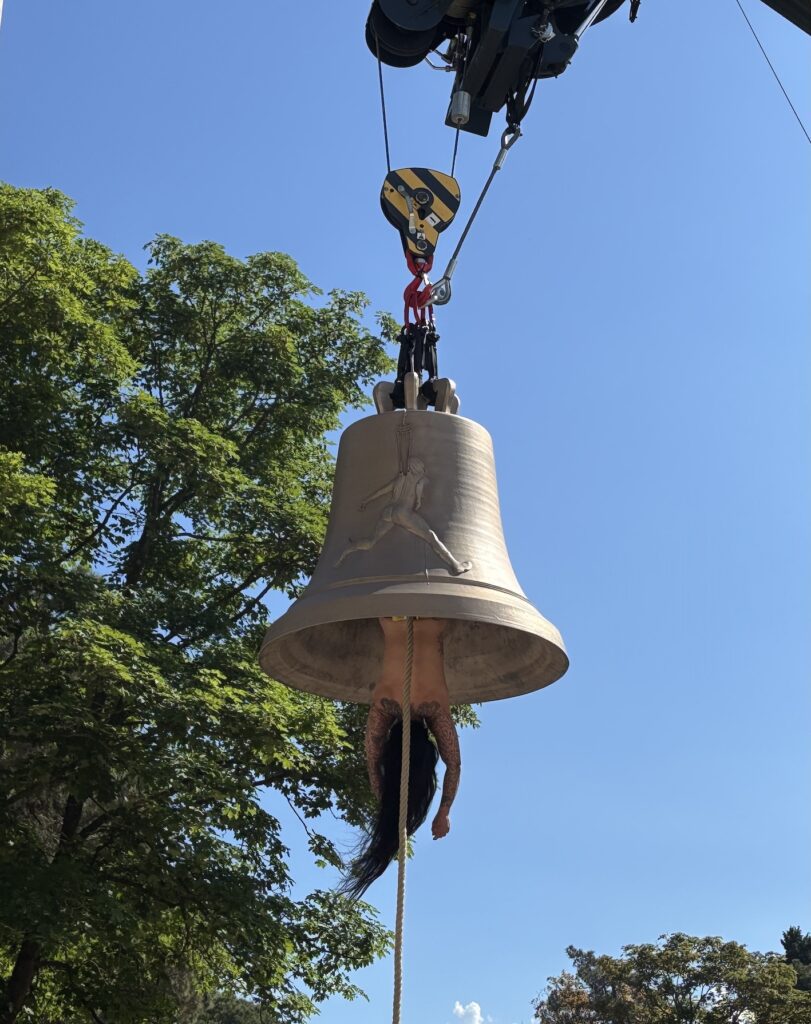
In a work that deliberately collapses the boundaries between performance, choreography, theatre, and installation art, Holzinger uses shock not as an end in itself, but as a strategy for pulling audiences into the layered structure of the piece.
As curator Nora-Svantje Almes explains, spectacle functions here as a point of entry for the audience: “The work operates on multiple levels, and shock is the first of them — it is there to make you look. You will see naked performers, an enormous bell with a performer hanging upside down inside it. That is the moment the work draws the audience in.”
Internationally recognised for performances grounded in extreme physical expression, Holzinger continues in Seaworld Venice her long-standing exploration of the body as a site of political, biological, and symbolic tension. Her practice — often involving nudity, bodily fluids and physical risk — moves between choreography, body-horror aesthetics and theatrical spectacle, making her one of the most distinctive figures in contemporary performance art.
The project also situates itself within a specifically Austrian artistic lineage concerned with the body, blood, and bodily secretions — from Viennese Actionists such as Hermann Nitsch and Günter Brus to contemporary performative practices that treat the body as a site of social and political conflict.
Conceived as a warning directed at a world that continues to ignore the consequences of ecological collapse, the performance unfolds through a rotating cast of performers alongside the artist herself. Every hour, one performer hangs inside the bell, another rides a jet ski, a third remains submerged in a tank filled with purified urine, while others occupy different parts of the installation.
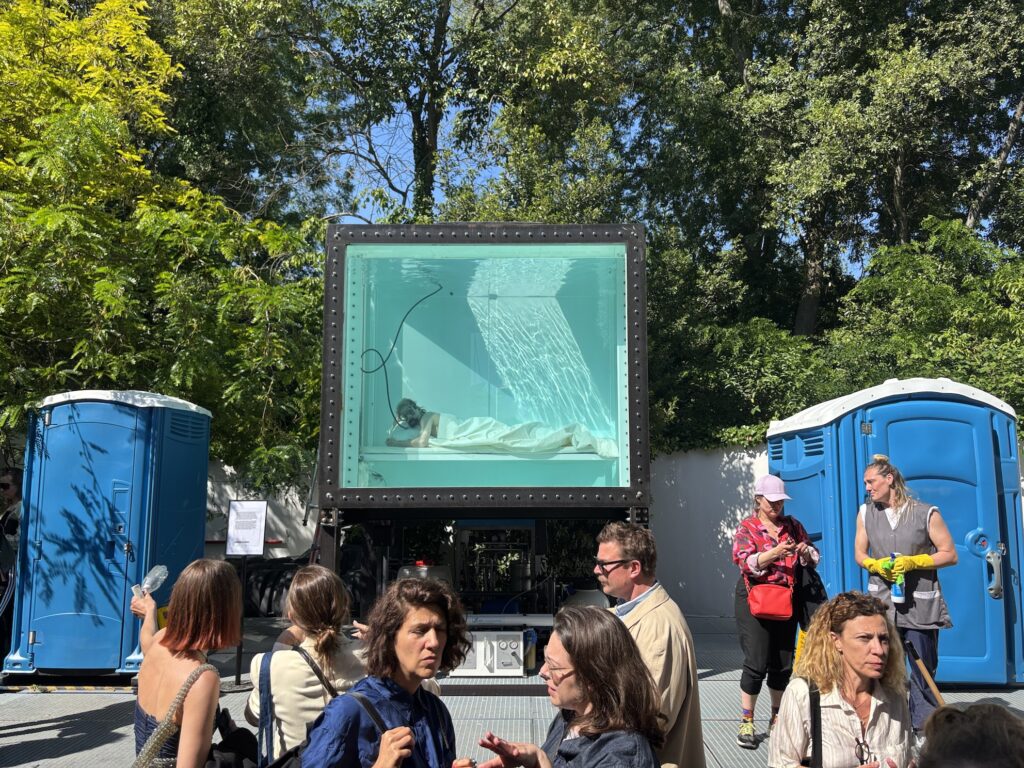
The entire project is conceived as a kind of “machine organism” — a hybrid structure that transforms the Austrian Pavilion into what the curatorial text describes as “a space somewhere between a water amusement park, a wastewater treatment plant and a sacred building.” These three systems — entertainment, infrastructure, and ritual — intertwine to produce a layered, immersive, and often deeply uncomfortable experience of the contemporary world.
At the centre of the project is water — an element that functions simultaneously as a natural resource and a globally regulated commodity. The water we drink and excrete, the water we enter and emerge from, transformed, becomes in Holzinger’s work a key material for rethinking the human body within a radically altered landscape where nature and technology increasingly overlap.
As both motif and material, water becomes an active force through which art, politics, and everyday life converge. Through live performances — including a performer who uses her own body to resonate inside the enormous bell — the work confronts mass tourism and climate collapse by imagining a world in which people are forced to exist within the waste generated by their own actions. In this context, the installation also gestures toward broader global power structures in which, as the project suggests, “vulnerable populations and entire nations are pushed into the garbage bins of the powerful.”

One of the work’s central gestures is the collapse of distinctions between the “clean” and the “contaminated”, the “private” and the “public”, the “sacred” and the “profane”. Bodily waste collected from two mobile toilets used by visitors becomes part of the installation’s closed ecosystem, radically erasing the distance between spectator and artwork. In doing so, the project implicates audiences directly in questions of responsibility, exploitation, invisible waste systems, and the limits of bodily autonomy.
Aesthetically and dramaturgically, Seaworld Venice constructs a dystopian vision of a world in which nature has already been fully infiltrated by industrial and digital systems. Venice — a city historically shaped by water — becomes an operational stage for reflecting on the climate crisis, tourism economies, and its own fragility. Paradoxically, the city survives through the very tourism that is simultaneously eroding it.
The work unfolds precisely within those contradictions. While criticising this paradoxical system, everyone present at the Biennale — artists and visitors alike — remains complicit in it. Rather than offering resolution, Seaworld Venice insists on a condition of permanent tension. Dirt, waste, and excess material are not hidden from view, but foregrounded as inseparable elements of the contemporary ecosystem.
Leave a Reply