
By Dragan Vojvodić //
Georg Baselitz (1938–2026) brings his artistic career, and his own physical existence, to a closing act in his final cycle of paintings. He does not depart from the themes and gestures that have remained central to his practice throughout his career: portraits of his lifelong companion Elke, figures of soldiers and heroes, eagles, forests. These are motifs Baselitz returns to for the last time, leaving them before the viewer as a kind of epitaph.
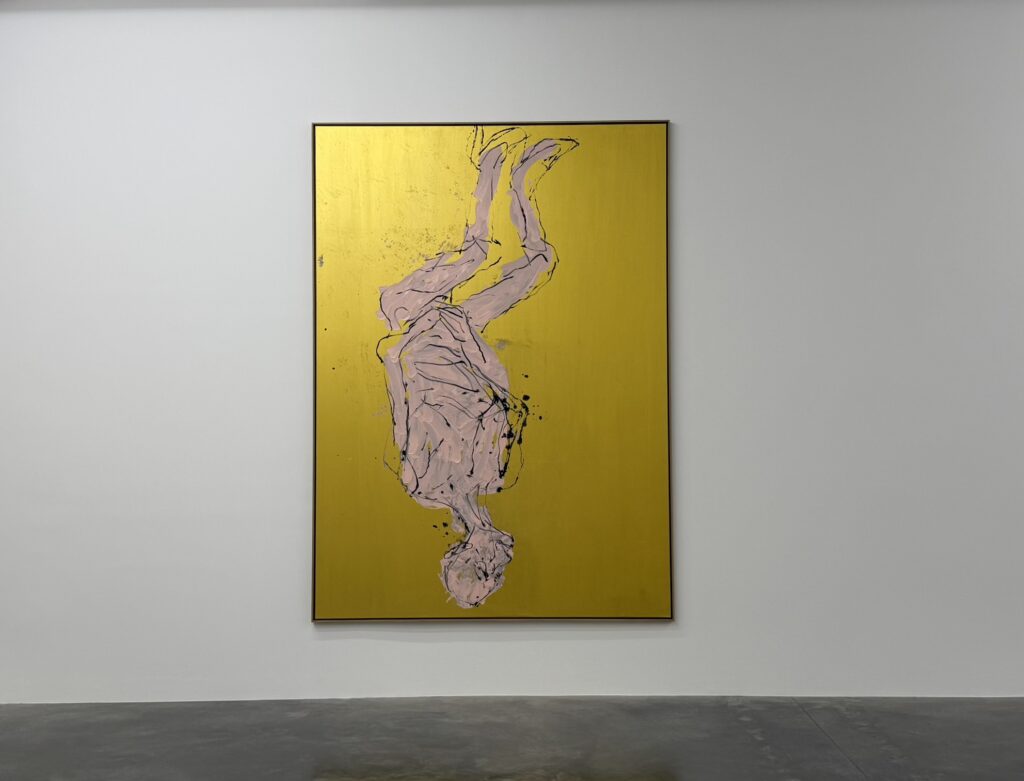
At White Cube Bermondsey in London from 10 June till 30 August 2026, a posthumous exhibition of Georg Baselitz’s paintings almost inevitably takes on a sacred character. Installed with extreme restraint, the paintings, despite their stripped-down expressive quality, become not only works by one of the most significant artists of the turn of the millennium, but also something like artefacts of his absence. The gallery space inevitably shifts from a place of exhibition to a space of remembrance.
The title of the exhibition, Back Again, which is also the title of one of the paintings from his final cycle, suggests that Baselitz, through his work, is once again among us, even though he is no longer physically present.
At the moment when he brings his life’s work to its final act, however sombre that may be, Baselitz does not abandon his desire for something new. Forced to spend his final months in a wheelchair, a circumstance that inevitably affected the act of painting itself, he transfers his physical limitations and difficulties onto the canvas, turning them into new means of expression. His figures, rendered with an even greater degree of expressiveness—or, more precisely, drawn with the brush—are crossed by lines and traces left by the wheels of his wheelchair. Confronted with physical limitations, Baselitz immerses himself more deeply in his own work, simultaneously creating and destroying it, producing a testimony to transience and human existence.
The act of painting becomes a performative act, an act of creating something unrepeatable. The statement by the renowned Yugoslav and Croatian performance artist Tomislav Gotovac that a performance cannot be repeated, just as one dies only once, acquires a particular resonance in Baselitz’s case. It becomes an imprint of colour on the canvas, like a Rorschach blot produced by his final act of painting.
His iconic upside-down approach, in this final cycle, is no longer simply a resistance to the dominance of abstraction, or to whatever else this device may have signified over the decades of his practice. It takes on a new, almost religious meaning, in conjunction with an entirely new and unexpected formal decision: the use of gold as a ground.
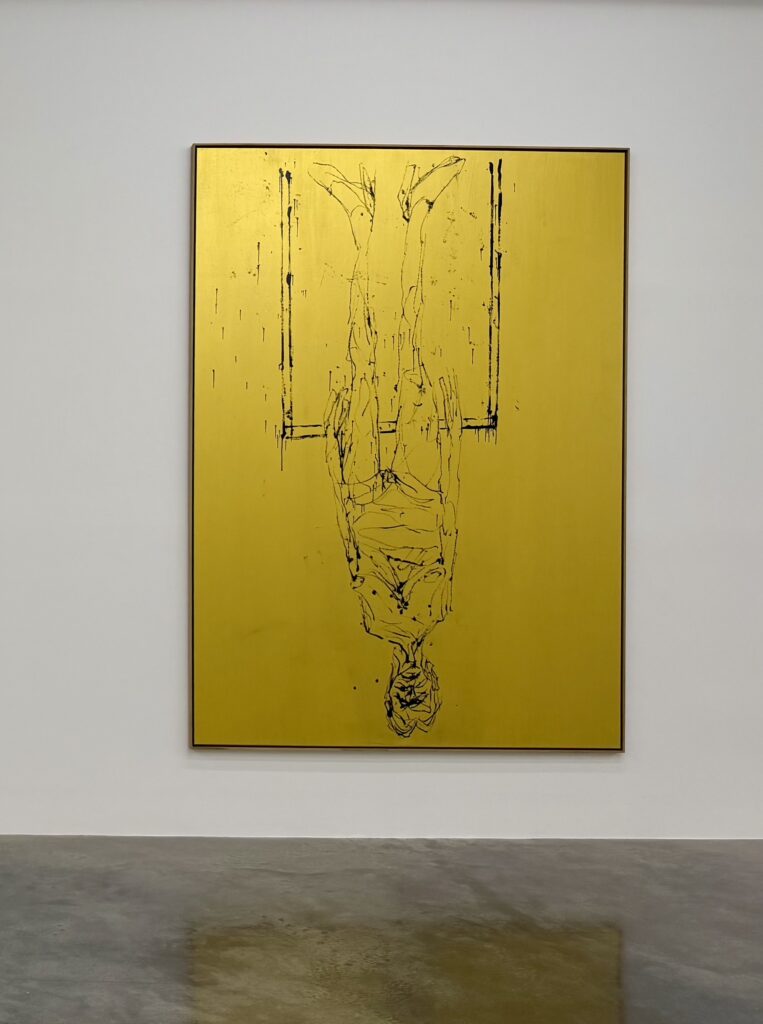
Gold extends across the entire canvas with an even, minimalist intensity, leaving Baselitz’s drawing to carry the full expressive force—in the epilogue to his artistic statement.
Why gold? The question inevitably arises. What did Baselitz intend to achieve through it? Is he drawing on the symbolism of gold as it has been used throughout the history of art?
On the contrary, for Baselitz, gold is neither merely decorative nor simply a symbol of holiness. White Cube emphasises that Baselitz returns to key motifs from his own oeuvre, while the gold ground becomes one of the principal formal devices of the final cycle.
Baselitz speaks to this in his final interview: “Black is the beginning of an aesthetic intention, gold is the end of that process.” After gold, he suggests, there is no further experimental principle to pursue.
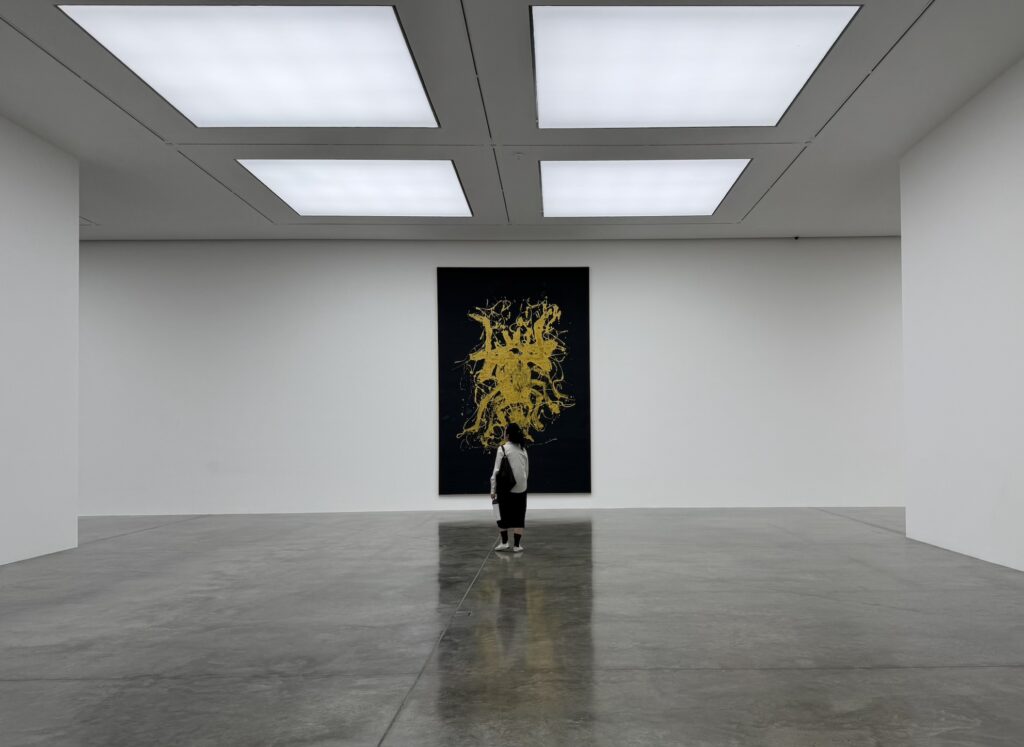
Although throughout his career Baselitz repeatedly reduced painting to a limited number of essential elements, the introduction of the gold ground represents, for him, an ultimate act of reduction. The gold ground abolishes pictorial space, and it is here that the sense of the sacred comes fully into focus. The figure is no longer positioned against a wall, a landscape or any identifiable setting; it exists within a kind of timeless, spaceless field.
This is particularly significant in Baselitz’s work because throughout his career he worked against the conventions of the picture: he turned figures upside down, disrupted the relationship between figure and ground, challenged perspective and questioned the hierarchy of the image. In this final body of work, he no longer destroys or destabilises space—he abolishes it.
The figure against a gold ground is no longer situated anywhere. It simply exists.
Although one might read this gesture in relation to the tradition of icon painting, Baselitz does not imitate that tradition—he subverts it. His figures are not saints. They are fragile figures: Elke, soldiers and heroes, eagles, and ultimately himself—the ageing figure becoming his final subject. He populates a sacred space with non-sacred figures, with the body and the existential world of human experience.
Everything is reduced to a final contradiction: gold suggests eternity, while the figures testify to transience.
In the end, Baselitz paints—or rather draws—his figures with the brush, using black to intensify this ultimate contradiction.
Gold is timelessness, light, eternity, the icon; black is the body, the trace, the gesture, transience.
Gold is not merely a ground. It radiates around and between the densely drawn lines. It is as though the figures have not been painted onto the surface, but are emerging from it—from the gold itself.
It is as though, through this final act, Baselitz confronts the sacred tradition of the icon and Renaissance painting with his own existential ending in an act of extreme irony. By populating these spaces of holiness with the human body, he speaks of transience—and of the final act, the act of bringing everything to an end.
Leave a Reply