
By Dragan Vojvodić //
On the second day of the Way Out West Festival in Gothenburg, some of the most influential bands to shape the music scene of the 1980s took to the festival’s two main stages, Flamingo and Azalea, set opposite one another and towering like multi-storey buildings. Nick Cave and The Bad Seeds and The Cure performed one after the other, bringing two defining acts of the era to the festival stage.
Although both bands have been part of the global music scene for decades and have long enjoyed cult status, their performances did not draw as large a crowd as that of Swedish pop star Zara Larsson. It almost felt as though the festival grounds had been cut in half after her performance. A large part of her audience even left the festival, giving the impression that they had no interest in the other acts.
And yet, major stars such as Nick Cave and Robert Smith—both, in their own ways, the alpha and omega of their respective bands—still manage to attract not only generations of devoted listeners but also a younger audience discovering their music for the first time. Among the large crowds eagerly awaiting their performances were fathers and sons, mothers and daughters.
This is one of the interesting characteristics of Swedish audiences and Swedish society, relatively free from ageism and predetermined cultural expectations—such as the idea that rock music is for the young and jazz for older generations. At Way Out West, such boundaries clearly do not exist.
Nick Cave as the Link Between the Band and the Audience
The Bad Seeds, fronted by the singular rock figure of Nick Cave, gave the audience everything they had. That impression never weakened, from the opening moment to the very end of the performance. Throughout the concert, there was a sense of witnessing a highly accomplished, meticulously conceived spectacle which, unlike much contemporary pop production, was visually restrained while musically rich and layered.
Cave has travelled a long way from his beginnings with The Birthday Party, from noise, chaos and extreme post-punk, through the early period of dark sounds and gothic aesthetics, to his current musical language, in which The Bad Seeds function almost like a large ensemble. At Way Out West, that evolution was particularly evident.
Compositions that are especially important to me, including From Her to Eternity, Tupelo, The Mercy Seat and Red Right Hand, have lost none of their original power or rawness. On the contrary, in their new, richly arranged performances, supported by powerful instrumentation and female backing vocals, they sounded even more intense and evocative. At certain moments, it almost felt as though a full orchestra with a choir was performing before us—a rock band transformed into something much larger, translated into an entirely different musical language.
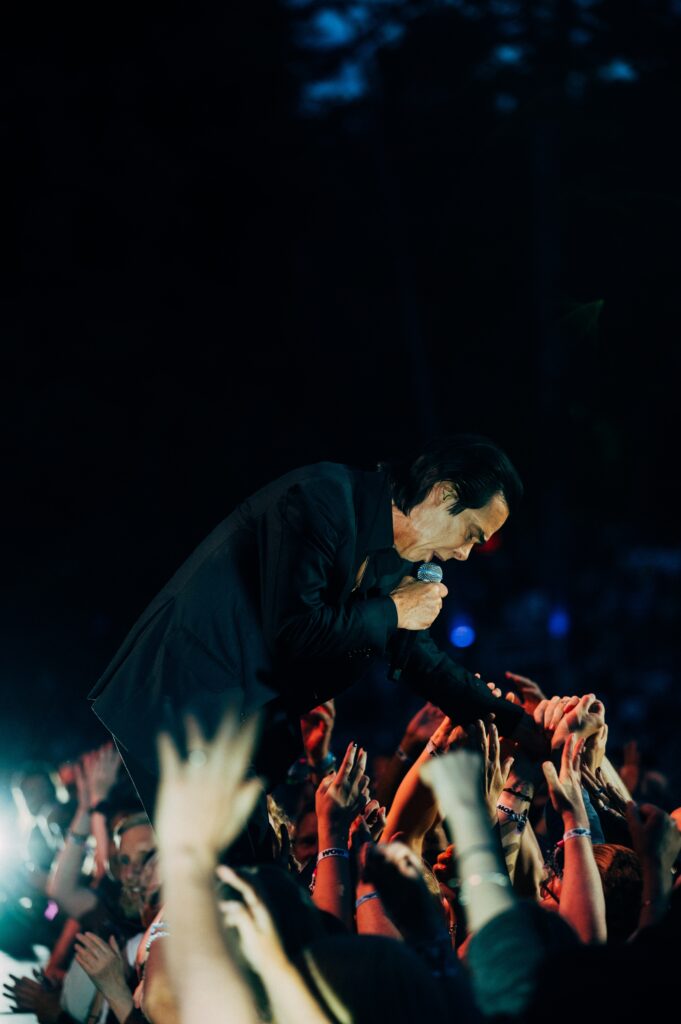
And yet, despite the exceptional musical foundation provided by The Bad Seeds, Cave remains the crucial link between the audience and everything happening on stage. His characteristic communication with the crowd, marked by physical contact, powerful gestures and direct exchanges with fans in the front rows, takes on almost cinematic proportions when magnified across the festival’s giant screens.
At one point, Cave literally steps down into the audience. They reach out and hold him up, while his movement through the crowd becomes an integral part of the performance itself. The audience is no longer merely watching; it becomes an active participant in creating the visual and emotional experience of the concert. These are precisely the moments that remain in the memory long after the music has stopped—as almost iconic images of contemporary rock culture.
From Noise and Chaos to Wild God
Creative potential is not limitless. Even the greatest musicians go through periods of change, exploration, transformation, and varying degrees of artistic success. Nick Cave’s body of work therefore cannot be viewed or evaluated according to a single set of criteria.
From the early dark alternative and post-punk sound, through blues, gospel and gothic aesthetics, to the introspective and emotionally complex music shaped by personal experience and loss, Cave has travelled a long and complicated artistic path. Along the way, he has explored a wide range of creative and performance forms which, quite understandably, will not appeal equally to every listener. This is the context in which the Way Out West setlist should be considered. It offers a cross-section of his work over several decades, and it is only natural that it will not satisfy every taste equally. What is difficult to dispute, however, is that the way The Bad Seeds performed these songs could hardly leave anyone indifferent.
Perhaps this is the most important experience of the concert: Nick Cave is no longer simply a performer of his own songs. He has become their interpreter in a broader, almost ritualistic sense. Songs written at different stages of his life, shaped by different aesthetics and personal experiences, acquired a new, shared form on the Way Out West stage.
Robert Smith and The Cure, mentioned at the beginning, undoubtedly deserve a text of their own, which will follow soon.
Leave a Reply