
Dragan Vojvodić //
London’s contemporary art scene, from 28 February to 19 April 2026, hosts Rose Wylie: The Picture Comes First at the Royal Academy of Arts. This retrospective brings together more than 90 works spanning Rose Wylie’s career, from her early autobiographical pieces to her most recent, previously unseen paintings.
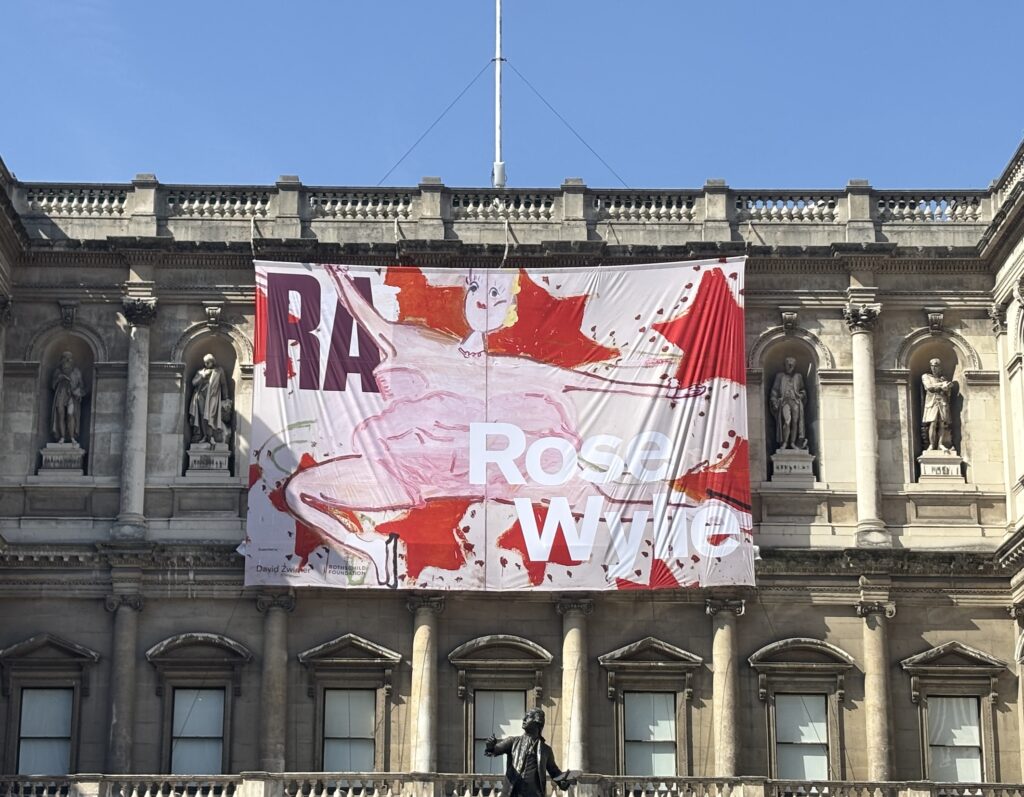
The practice of Rose Wylie—still often described as a “rebel” within the British art scene—draws together everyday life, cultural fragments, press imagery, cinema, and personal history into a visual language that is playful yet attentive, and deeply observant. Drawing sits at the core of her work: she draws daily, building a personal archive of motifs that later surface in her large-scale paintings. Among her most recent works are four monochrome animal paintings, where pigment is applied directly by hand, foregrounding a raw, physical approach to painting.
“It shouldn’t matter how old you are, or your gender, or anything else. It should only be about the quality of the painting,” she remarked in an interview with The Guardian. Wylie began painting seriously only in her fifties, achieving wider recognition in her seventies. Her work carries a sense of immediacy, energy, and freedom that feels rare in contemporary painting, echoing Pablo Picasso’s well-known observation that it takes a lifetime to learn how to paint like a child. In this sense, her practice seems to slip past dominant currents in contemporary art, maintaining a distinct autonomy of expression.
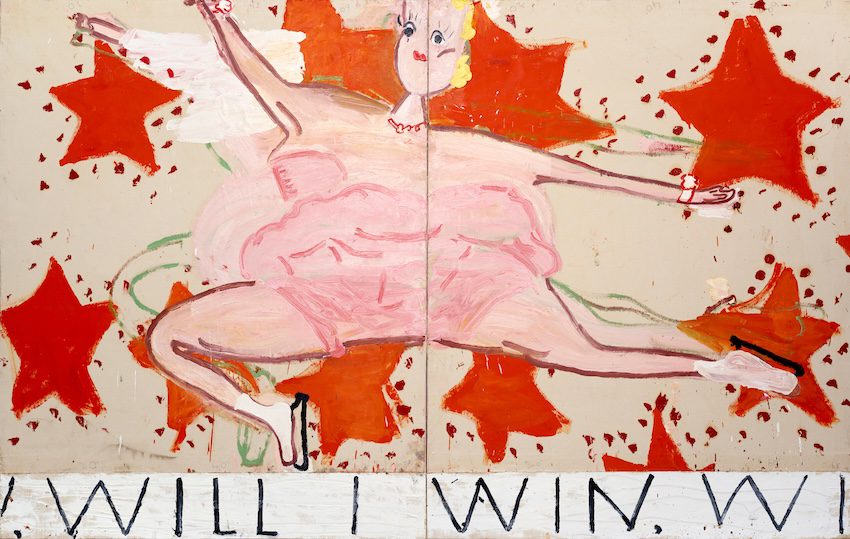
Her work is rich in references to film, celebrity culture, literature, and ancient civilisations. Her cast of characters—predominantly female—includes figures such as Elizabeth I, Nicole Kidman, Marilyn Monroe, Serena Williams, and Snow White. These cultural and historical references are interwoven with her own experiences, including memories of the Blitz, which she lived through as a child.
Wylie’s seemingly imperfect female figures—often read as psychological self-portraits—expand from sketch-like beginnings into large-scale works, propelled by a childlike imagination. Yet this “imperfection” is not a lack of skill but a deliberate aesthetic decision, resisting academic conventions. Her compositions function less as static images and more as visual montages: fragments of personal and collective memory, combined with her fascination with film and popular culture, produce works shaped by shifting perspectives and narrative cuts.
A distinctive layer within her work is formed by handwritten notes and textual elements, which push the paintings towards a hybrid space between image and diary. Inflected with a dry, distinctly British humour and irony, this approach introduces a critical distance from the grand narratives of painting, blurring the boundaries between high and low cultural codes.
Wylie works on a large scale, with a looseness that never quite tips into chaos, remaining instead within an intuitive but considered structure. Her paintings feel like thinking in motion—an ongoing, visual reworking of perception and memory.
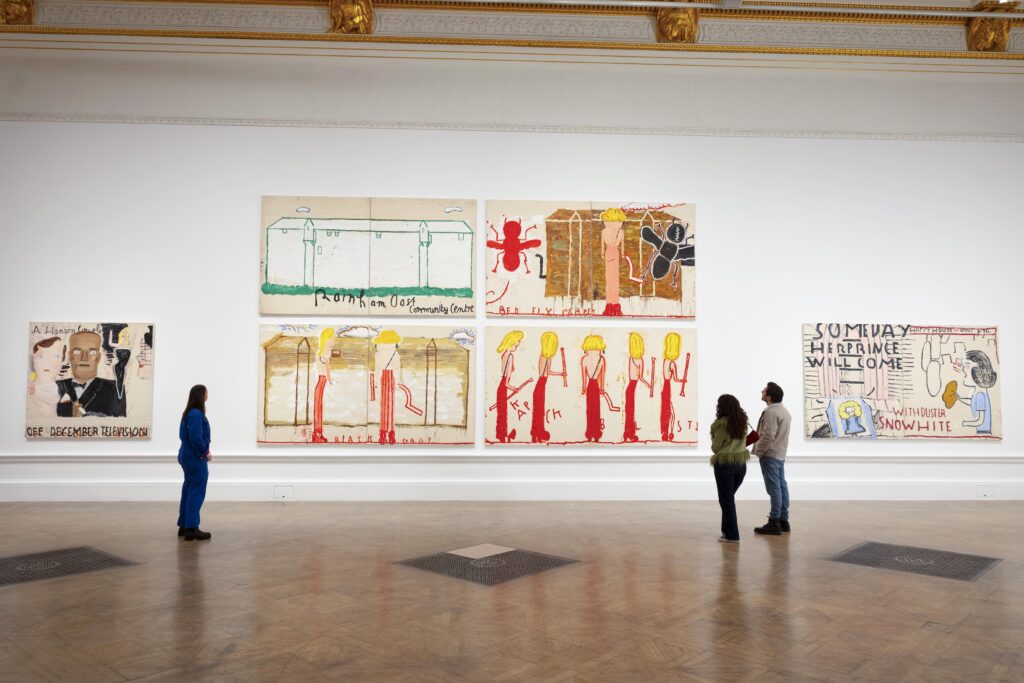
The exhibition at the Royal Academy of Arts is structured thematically, offering an insight into the evolution of her work and the ways in which everyday motifs are transformed into complex visual compositions. From newspaper references to autobiographical fragments, it becomes clear that Wylie consistently returns to a single premise: the painting comes first, and it emerges through an unguarded, painterly act.
Rose Wylie (1934) studied at Folkestone and Dover School of Art and later at the Royal College of Art. She represented the UK at international exhibitions, including Women to Watch at the National Museum of Women in the Arts (2010). Major retrospectives include presentations at Jerwood Gallery (2012) and Tate Britain (2013), followed by exhibitions across Europe and the United States. She has received the Paul Hamlyn Award (2011) and the John Moores Painting Prize (2014). Her works are held in numerous public and private collections, including Tate Britain, the Arts Council Collection, the Jerwood Foundation, the Hammer Collection, and York Art Gallery. Alongside her practice, she remains active in education, giving talks and lectures at institutions such as the Royal College of Art, Slade, Goldsmiths, Wimbledon College of Art, The Royal Drawing School, ICA, and Tate Britain.
Leave a Reply