
By Ljiljana Maletin Vojvodić //
I read Baumgartner, Paul Auster’s final novel, published in Serbian by Geopoetika in 2024 in Ivana Đurić Paunović’s translation, only after watching Sabine Lidl’s documentary Dance Around Self about Siri Hustvedt and reading her memoir Ghost Stories. In Auster’s novel, a man who has lost his wife tries to preserve her traces; in Hustvedt’s book, it is a woman who does the same. The fact that Auster writes from the perspective of possible loss, while his wife writes from the experience of it, shaped my reading of the novel around the dialogue between these two books.
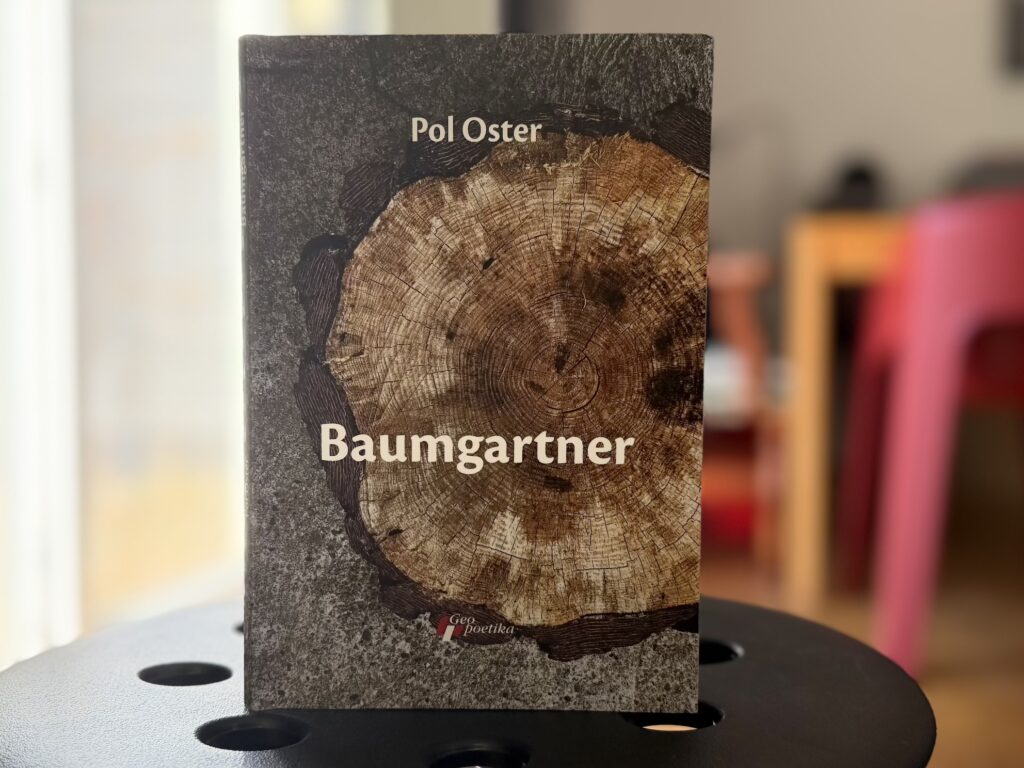
Baumgartner is a writer, professor of philosophy, and widower. For ten years, he has been living without Anna, the woman he spent almost forty years with. Yet she remains present in his life through her diaries, poems, memories, and the routines of everyday life. The novel begins with Baumgartner going through a series of seemingly minor everyday mishaps. He fails to make a simple phone call to his sister, burns himself on a hot saucepan, and then, for no particular reason, goes down to the basement and falls down the stairs. From there, we follow his inner life: his thoughts and memories, and the ways in which the past continues to shape the present.
One of the book’s important metaphors is the phantom limb. A person who has had an arm amputated can still feel pain, itching, or pressure in a limb that is no longer there. Baumgartner has lost Anna, but his relationship with her has not disappeared. He still loves her, addresses her in his thoughts, and connects the objects around him with her.
While finishing the novel, Paul Auster began experiencing mysterious fevers in the afternoons. He was first diagnosed with pneumonia and eventually with cancer, from which he died.
Hustvedt describes something remarkably similar after his death: he is no longer there, but his chair remains, as do his books, manuscripts and habits. She constructs her book from diary entries, emails, memories, letters, and Auster’s writings. It also contains his final unfinished work, written for their grandson, Miles.
Both Auster’s Baumgartner and Siri Hustvedt’s memoir Ghost Stories explore life after loss and can be read alongside one another. Auster creates a fictional narrative about a man who has lost his wife, while Hustvedt writes about the loss of her husband, Paul Auster.
In Auster’s novel, a woman leaves her writings to a man. In Hustvedt’s book, a man leaves his writings to a woman. In Baumgartner, Auster writes about a man trying to continue his life after his wife’s death; Hustvedt writes about continuing to live after Paul’s death. Auster wrote a fictional version of an experience his wife would later have to live through herself. There is no reason to regard these parallels as some kind of mystical prediction, but the similarities are striking.
Siri Hustvedt was Auster’s wife for more than forty years. She was his interlocutor and first reader, the person with whom he shared everyday life, books, conversations, and literature. Anna, therefore, could hardly have emerged entirely independently of Siri, even though she cannot simply be read as Siri Hustvedt. Just as Baumgartner cannot simply be read as Paul Auster.
There is also a difference in the way the two approach literature. Although both books explore what happens when we lose someone who has been part of us for decades, Auster creates a work of fiction with a carefully considered form, rhythm and structure. Hustvedt leaves the traces of experience as they are — fragmented, formally uneven and associative. In Auster’s novel, literature becomes a way of exploring loss and memory; Hustvedt turns memory itself into literature.
There are numerous recognisable parallels between Baumgartner and the lives of Auster and Hustvedt: a long marriage between two writers, their shared relationship with literature, ageing, conversations, books and memories. What remains open is the question of what Auster took from his own life and marriage, and what he had to change in order to transform that relationship into fiction. And what does that transformation tell us about his relationship with Hustvedt, but also about their relationship to ageing, loss and memory?
After Auster died in 2024, Baumgartner can no longer be read simply as a story about an imaginary widower. It is also read through the absence of its author and through Siri Hustvedt’s book.
Perhaps this is why Baumgartner and Ghost Stories can be read as a kind of continuing dialogue, even though Siri is not Anna.
She is, rather, Baumgartner.
Leave a Reply