
By Ljiljana Maletin Vojvodić //
Siri Hustvedt is hardly a new name on the literary scene. Since the publication of her first novel in the early 1990s, the Norwegian-American writer has built a distinctive body of work encompassing novels, poetry, essays and books that move between literature, art, psychology and contemporary society. Yet in the wider public imagination, she was often defined through her relationship with Paul Auster. They were one of New York’s best-known literary couples. Auster enjoyed considerable international recognition, particularly following The New York Trilogy, while Hustvedt, despite her own substantial literary career, was often perceived first and foremost as his wife.
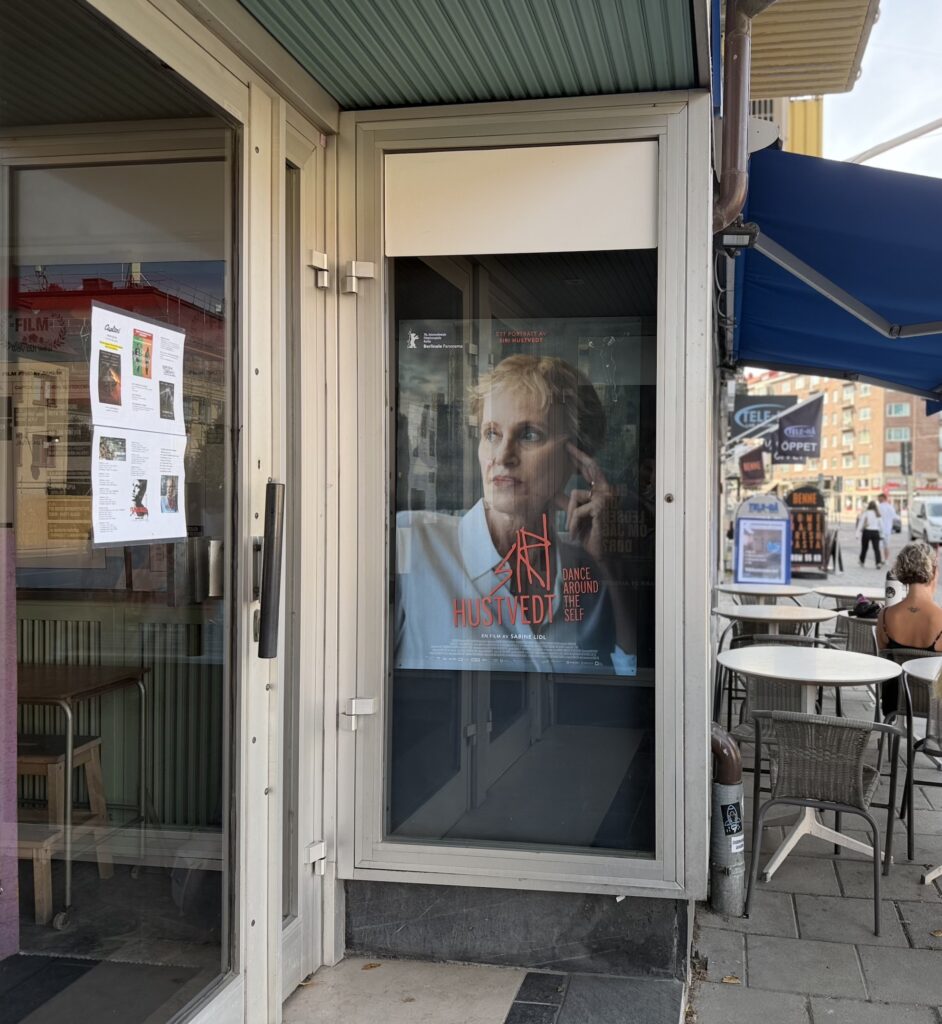
After Auster’s death in April 2024, Hustvedt published Ghost Stories, a book somewhere between memoir and personal essay, reflecting on forty-three years of their life together, as well as his illness and death. The book attracted considerable international attention and brought a new level of visibility to Hustvedt. At the same time, public attention turned to Sabine Lidl’s documentary Siri Hustvedt – Dance Around the Self, which had its world premiere at the 2026 Berlinale and was also screened this year at Way Out West in Gothenburg, where it had its Nordic premiere.
Both the book and the film are examples of a somewhat paradoxical, yet perhaps inevitable, situation: Hustvedt is more visible than before at precisely the moment when she is no longer part of one of the best-known literary couples. And yet both the memoir and the film that have brought her renewed attention are, to a considerable extent, about Auster — their marriage, their life together and their shared relationship with writing.
The film does not begin with their meeting, however, but much earlier, in 1978, when a young Siri Hustvedt leaves Minnesota for New York. At Columbia University, she studies English literature and begins working on her first novel.
In Super 8 reconstructions, a young woman walks through the streets of Manhattan in search of the subject of her future novel. The motif of searching becomes a physical journey through the city, while the search for a character also becomes a search for her own voice.
Throughout the film, Hustvedt reads passages from her books and talks about the creation of characters, the relationship between experience and fiction, and the way personal experience changes once it becomes literary material.
This is particularly relevant given the way her work has often been read. Her novels have frequently been interpreted as autobiographical, something she has questioned throughout her career. The film returns to precisely this boundary between the author and her characters, between what is lived and what is written.
Paul Auster is present in the film. We see him in earlier footage speaking about Hustvedt and her writing, while their shared memories offer glimpses into both the personal and everyday aspects of the life they spent together.
Yet Dance Around the Self is not a film about a literary couple.
That is, in fact, one of its strengths.
Sabine Lidl had already directed the documentary Paul Auster – What If in 2019. The experience of making that film eventually led to the idea of turning the camera towards Hustvedt. This time, the perspective is different: Auster remains part of the story, but at its centre is the writer herself and the way she thinks.
Hustvedt talks about literature, but also about philosophy, feminism, art history, psychology and contemporary society. Her subjects constantly intersect, much as different fields of knowledge intersect in her books.
The film follows this way of thinking through a combination of conversations, archival footage, photographs, animation and passages from her writing.
Particularly significant are the women who have influenced her work and thinking: Louise Bourgeois, Margaret Cavendish and Elsa von Freytag-Loringhoven. Their presence also raises the question of the visibility of women artists and writers who, in their own time, often remained outside the main currents of cultural history.
Hustvedt has had an independent literary career for decades. Her books have been translated and read around the world, while her interests and work have extended well beyond literature. Still, it seems that the way she is being discussed has changed in recent years.
Ghost Stories is an important part of that shift. The book is closely connected to Auster’s illness and death, but it is also a deeply personal account of forty-three years of shared life, writing, memory, and grief. Hustvedt draws on diaries from the period of his illness, emails exchanged with friends, old letters to Auster, as well as his final unfinished book intended for their grandson.
Something is striking about the fact that it was a book about Auster that once again brought the question of Siri Hustvedt as an independent author to the foreground.
For years, the story was that of a famous literary couple. Now there is a growing interest in one of the two people who made up that couple. And this is where the paradox lies: the renewed international attention surrounding Hustvedt comes through a story in which Auster is still very much present, while at the same time that very story has allowed her voice to be heard more distinctly.
Dance Around the Self is therefore interesting both as a portrait of a writer and as a documentary that moves beyond conventional biography.
Lidl follows Hustvedt from Minnesota and her early years in New York through her literary work and intellectual interests to the present day. Auster appears in the first part of the film, and as the story unfolds, it becomes clear that the filming took place during a period that would ultimately end with his death.
This gives the film an additional layer, but does not turn it into a film about grief. Much more space is devoted to Hustvedt as a writer, to her books and to the ideas that inform her work.
She speaks about the need for constant self-questioning, about art, the body, memory, and the relationship between who we think we are and how others perceive us. Her sense of self is not something fixed once and for all. It changes with experience, time, and our relationships with others.
Hence the title of the film, Dance Around the Self — a continual movement towards and away from what we call the self.
Perhaps Hustvedt herself has not changed as much as the perspective from which we see her has.
Since Auster’s death, with the publication of Ghost Stories and now the arrival of this documentary, her international visibility has taken on a new dimension. And there is a certain irony in this: for an author who had already spent decades building her own literary career, wider attention has once again come through — Auster.
But Dance Around the Self leaves enough room for that story to gradually shift away from him and towards the writer herself, whose work extends far beyond the biography of one literary couple.
Leave a Reply