
Art Box portal //
The exhibition We Who Remain – Sámi Art in Focus, on view at the Museum of Contemporary Art Kiasma in Helsinki until 6 September 2026, is one of the most comprehensive presentations of contemporary Sámi art in recent years. Bringing together works by more than twenty artists from across the Sápmi territories of Finland, Sweden, and Norway, the exhibition offers a powerful insight into the history, identity, resilience, and artistic expression of the Indigenous people of northern Europe.
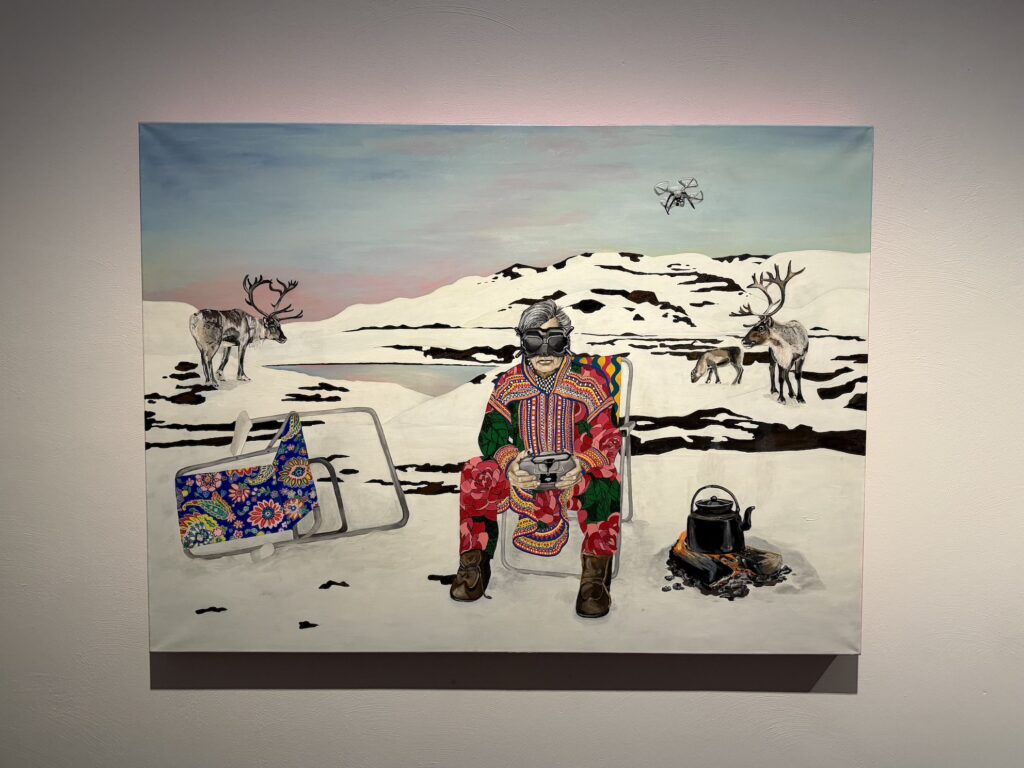
Organised jointly by Kiasma and the Sámi Museum Siida, and curated by Petra Laiti, the exhibition invites visitors to explore Sámi identity as expressed by the Sámi themselves. Rather than presenting an outside perspective, We Who Remain foregrounds Indigenous voices and lived experiences, revealing both the richness of Sámi culture and the lasting consequences of colonisation, assimilation, and historical injustice.
The Sámi are the Indigenous people of northern Europe. Their homeland, Sápmi, existed long before the emergence of the Nordic nation-states and their national ideologies. Today, Sápmi stretches across present-day Norway, Sweden, Finland, and Russia. The Sámi belong to the wider family of Arctic Indigenous peoples, and their traditional culture is rooted in fishing, hunting, reindeer herding, gathering, and duodji, the distinctive tradition of Sámi handicrafts.
Featuring more than twenty artists, the exhibition focuses primarily on works created between the 2000s and the 2020s, while also including several earlier works dating back to the 1970s. Across these decades, the Sámi community has continued its struggle for recognition under Nordic law, cultural self-determination, and greater international visibility.
“Contrasts are ever-present in Sámi contemporary art. The works convey the sensitivity and emotional depth of Sámi life, while also revealing the forces that have hardened us and shaped us into survivors. For Sámi visitors, they reflect our community’s self-respect, joys, and sorrows. For Finnish audiences, they offer distinctly Sámi perspectives on Sámi life,” says curator Petra Laiti.
Toward Reconciliation
The exhibition is particularly significant following the publication of the final report of Finland’s Sámi Truth and Reconciliation Commission, submitted in December 2025 to the Finnish Government, the Sámi Parliament, and the Skolt Village Assembly. Containing 68 recommendations aimed at improving the status of the Sámi people, the report acknowledges Finland’s responsibility as a country founded on the homelands of two peoples and calls for concrete measures toward reconciliation.
“This joint exhibition represents a new form of cooperation that could be further expanded between Finns and Sámi,” says Laiti.
As Kiasma Director Kiira Miesmaa points out, contemporary art creates space for multiple narratives while amplifying voices that have too often remained unheard.
“This exhibition is one way of making space for Sámi voices. I am delighted that we can present it in collaboration with the Sámi Museum Siida and curator Petra Laiti,” she says.
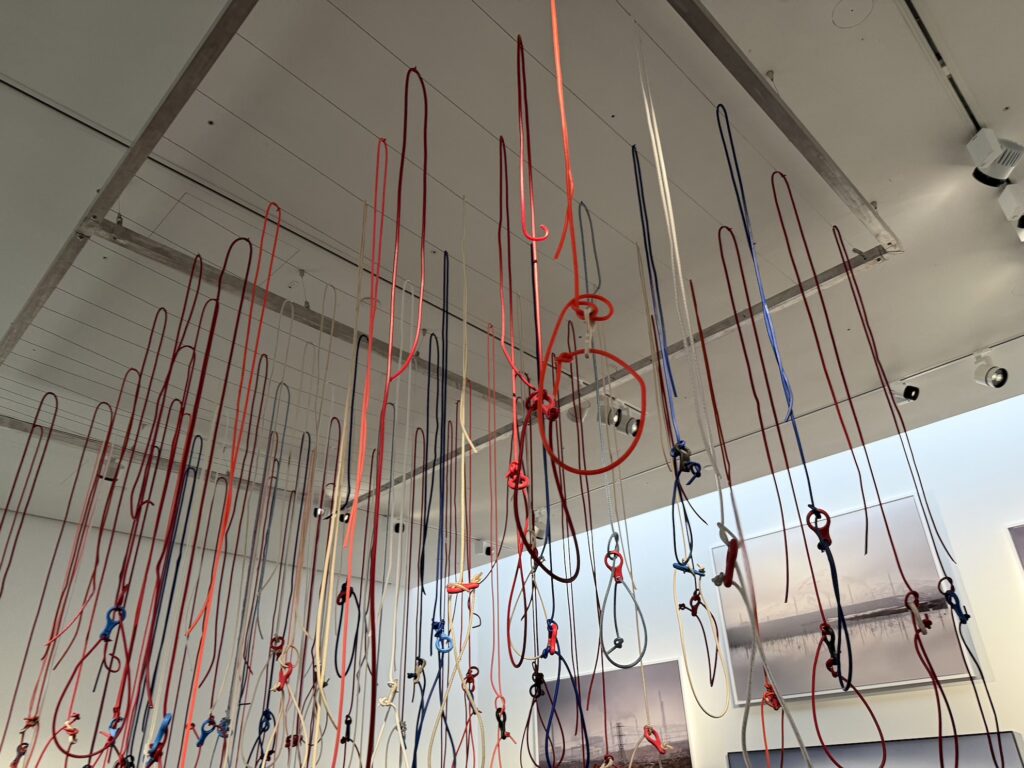
For Taina Máret Pieski, Director of the Sámi Museum Siida, it is especially meaningful that Helsinki is hosting such a comprehensive exhibition of contemporary Sámi art.
“Contemporary Sámi art and duodji are experiencing a renaissance and attracting great international interest. I am very pleased that Kiasma accepted our proposal for collaboration, enabling us to present a curated selection of works from Siida in Sápmi,” says Pieski.
Laiti also draws attention to the broader political context:
“Although the Arctic is receiving unprecedented global attention, the status of the peoples who live there is not necessarily improving. Critical issues—including land rights and the exploitation of natural resources—risk being overshadowed by NATO-related debate. These challenges affect Arctic Indigenous peoples such as the Sámi and Inuit alike, making it all the more essential that our stories are told and our voices heard.”
The exhibition features works by Siri Baggerman, Tomas Colbengtson, Gabriel Engberg, Marja Helander, Rose-Marie Huuva, Berit Marit Hætta, Johdet x Pirak, Márjá Karlsen, Hans Ragnar Mathisen, Britta Marakatt-Labba, Joar Nango, Outi Pieski, Katarina Pirak Sikku, Raisa Porsanger, Jorma Puranen, Máret Ánne Sara, Eveliina Sarapää, Hilde Skancke Pedersen, Katarina Spik Skum, Lena Stenberg, Lada Suomenrinne, Arvid Sveen, Tapio Tapiovaara, Nils-Aslak Valkeapää, Niillas Holmberg, and Pekka Aikio.
Stories Behind the Works
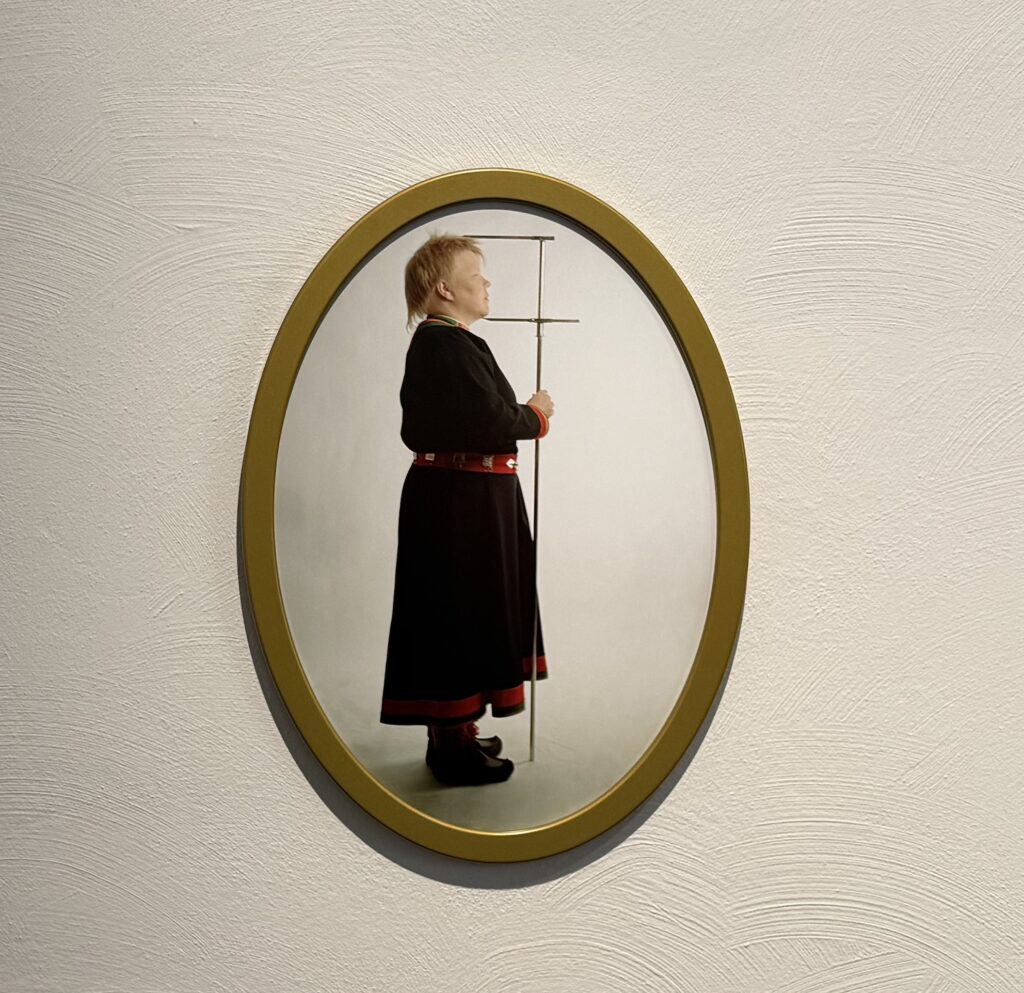
Among the participating artists is Katarina Pirak Sikku, whose practice explores grief, identity, ethnicity, and power through the lens of historical injustice.
“I believe we have been affected by historical events that happened to the Sámi people. We carry with us a silent legacy from past generations.”
In her photographic series Dollet (Grasp), Pirak Sikku appears wearing traditional Sámi dress while framing her face with a metal measuring instrument—the same type of tool used during racial biology expeditions conducted in northern Sweden in the 1920s.
For years, the artist has researched Sweden’s history of racial biology through archival investigations. During the early twentieth century, pseudoscientific theories dividing humanity into hierarchical races gained widespread acceptance across Europe, including the Nordic countries. The Swedish State Institute for Racial Biology, established in 1922, subjected Sámi people to invasive examinations, measuring their bodies, skulls, and facial features and photographing them nude.
Pirak Sikku revisited the places where these examinations took place and photographed them. She also sought out Sámi individuals who had been measured, recording their testimonies. Through her work, she symbolically places herself in the position of those who were once treated as objects of scientific research.
“Can grief be inherited?” she asks.
(Source: Sanna Hirvonen, Senior Planning Officer.)
Another compelling contribution comes from Márjá Karlsen, who presents an upright loom together with a work in progress—a rátnu, one of the oldest known forms of duodji, the traditional Sámi handicraft.
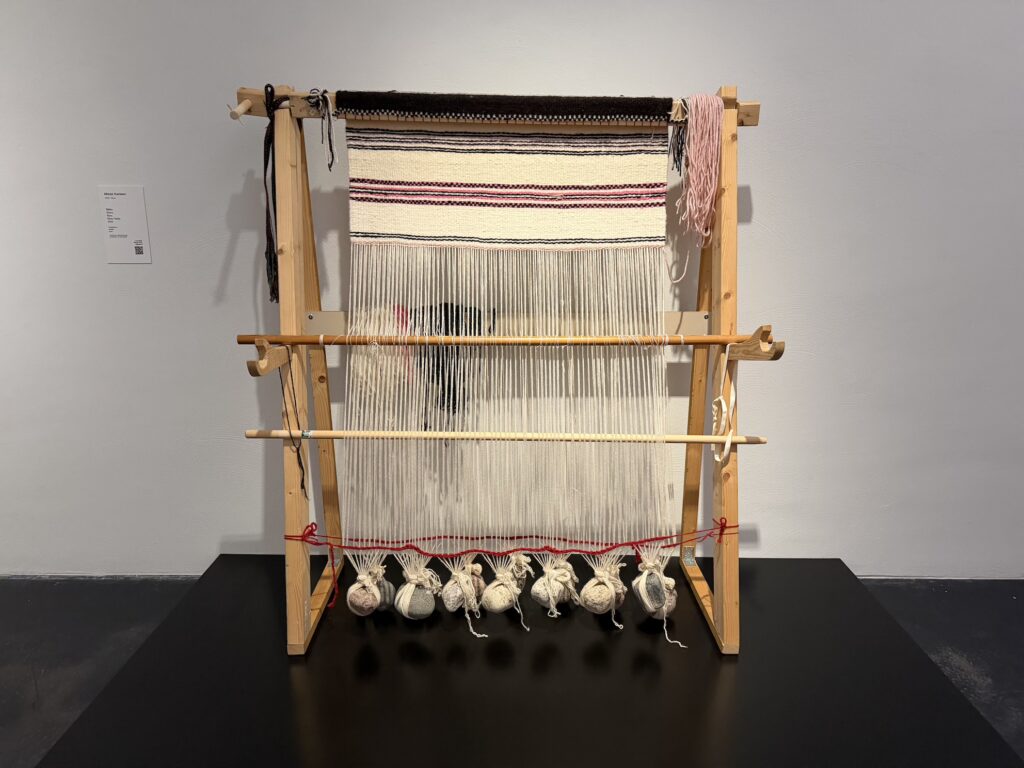
Karlsen is both an artist and a duojar (a Sámi craft practitioner), although she did not grow up learning traditional Sámi crafts. Coming from a family that was, in her words, “heavily assimilated” into Norwegian culture, she explains:
“We lost most of our duodji traditions.”
For Karlsen, reclaiming duodji is an act of cultural resistance.
“It’s like saying: ‘No, you didn’t get us. We’re still here!’”
She even weaves during political protests, bringing traditional craftsmanship into spaces of activism.
“Duodji embodies the love and energy of the Sámi community. When we are in crisis mode and protesting, it brings strength and comfort.”
For this exhibition, Karlsen deliberately chose to display not only the finished textile but also the loom itself.
“It shows that we’re still doing this. The making process is just as important as the result.”
She carries out nearly every stage of production herself—from washing and dyeing the wool to spinning the yarn—following traditional methods that require considerable time, knowledge, and dedication.
“Duodji represents our land, language, ancestors, family, and future generations.”
Source: Sanna Hirvonen, Senior Planning Officer.
Leave a Reply