
Art Box portal //
The Victoria and Albert Museum (V&A) in London presents Lasting Impressions: Women Printmakers 1900–Now, an exhibition that brings together the work of twenty-five women artists whose practices have significantly shaped the history of printmaking over the past century.
Spanning from 1900 to the present day, the exhibition traces the evolution of printmaking from traditional techniques such as etching, lithography, and woodcut to contemporary experimental approaches, highlighting the medium not only as a tool of reproduction but also as a site of artistic inquiry, political agency, and social critique. The exhibition is on view in Leighton Room 102 at the V&A’s South Kensington site until 27 September 2026.
Unlike many historical surveys of printmaking that privilege canonical figures, this presentation shifts attention to women artists whose contributions have often been marginalised within dominant art-historical narratives. Through a century-long arc, it follows how printmaking has shifted from a medium used to document social injustice in the early twentieth century to a contemporary field engaged with ecology, migration, identity, and institutional critique.
A key figure in the exhibition is Käthe Kollwitz, whose prints remain among the most powerful examples of socially engaged art. Her etchings and lithographs, focused on themes of poverty, labour, war, and loss, demonstrate the capacity of printmaking to function as a form of social testimony. In contrast, contemporary works on display reveal the expansion of the medium’s possibilities, from experiments with industrial materials and photopolymer plates to the use of natural pigments, recycled matter, and hybrid printing processes.
The exhibition also foregrounds the diversity of artistic approaches within contemporary printmaking. From Laura Knight’s theatrical scenes and Pearl Binder’s urban lithographs, to Faith Ringgold’s narrative prints that weave together visual form and African American history, and the experimental practices of Cornelia Parker, Ky Lewis, and Gal Leshem, the show makes clear that printmaking today is defined less by technique alone and more by how artists think through the image, the matrix, and the process of reproduction.
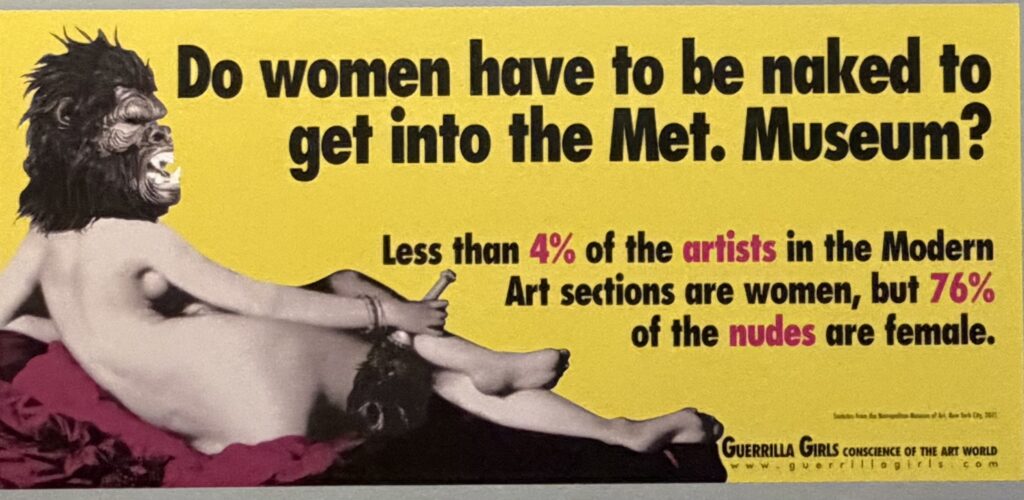
A significant section of the exhibition is dedicated to artists and collectives who have used printmaking as a form of activism. In the 1970s and 1980s, the feminist collective See Red Women’s Workshop produced screenprints that challenged gender stereotypes and social inequality, while the Guerrilla Girls deployed posters as a means of exposing gender and racial imbalance within museums and galleries. With its inherent reproducibility and capacity for wide circulation, printmaking emerges here as a crucial medium of political communication and public dissent.
Rather than offering a singular narrative of women’s printmaking, Lasting Impressions presents a constellation of artistic positions bound together by the medium itself. In doing so, it not only maps the development of printmaking as an artistic discipline, but also underscores how, across the twentieth and twenty-first centuries, women have used print as a space for experimentation, public address, and critical engagement—leaving a lasting imprint on the history of contemporary art.
Leave a Reply